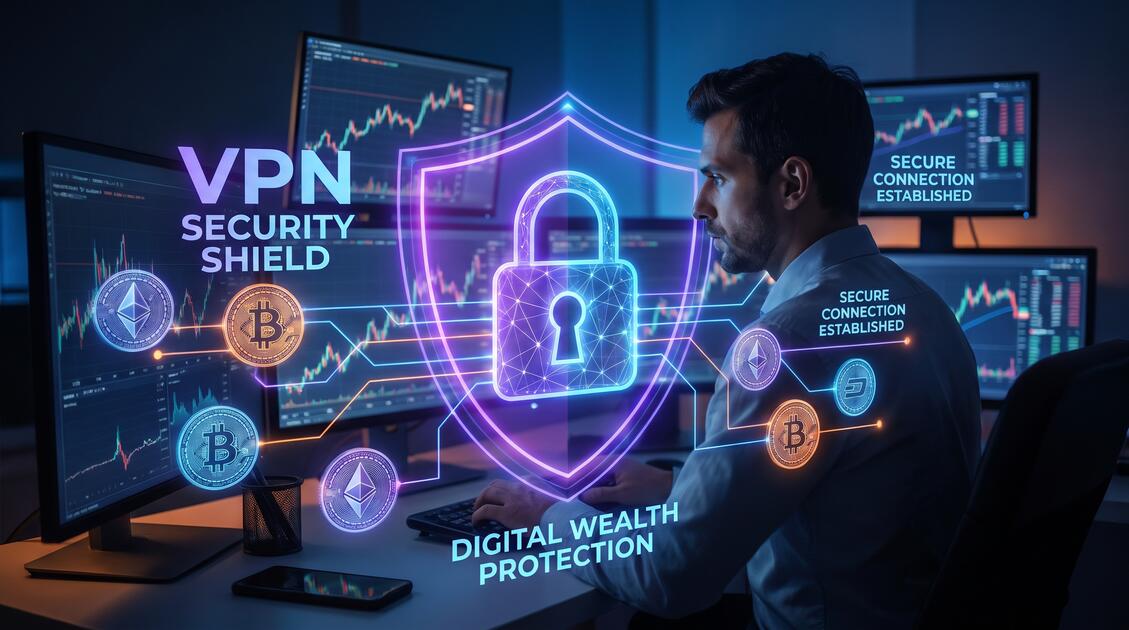
Cryptocurrency traders and digital asset investors manage extraordinary wealth in an entirely digital form—where a single compromised password, stolen seed phrase, or SIM swap can result in permanent, irreversible loss of $100K to $100M+ in assets. Unlike traditional financial accounts where banks can dispute fraudulent transactions, cryptocurrency transactions are final. This guide explores the ultra-high-value cyber threats targeting crypto traders, the devastating consequences of each threat, and how a multi-layered security strategy powered by Free VPN can protect your digital wealth.
Why Crypto Traders Are Ultra-High-Value Targets
Cryptocurrency traders represent one of the most attractive targets for cybercriminals in 2026. A single trader managing $500K to $100M+ in digital assets carries far greater financial impact than most other professions. What makes crypto traders especially vulnerable is the nature of cryptocurrency itself: irreversible transactions, no chargebacks, and complete digital existence.
Consider these striking statistics:
- 7.4 million cryptocurrency traders globally — managing an estimated $2+ trillion in digital assets
- 42% of active traders access exchanges on public WiFi — without VPN protection
- 86% of cryptocurrency investors have never used a VPN — despite managing life-changing wealth
- $14.9 billion in crypto stolen in 2025 — averaging $50K-$5M per major incident
- Zero recovery rate for cryptocurrency theft — once stolen, crypto is gone forever
Unlike a compromised bank account, where a bank employee might recover your funds, a hacked cryptocurrency wallet has precisely zero recovery options. Attackers extract funds, immediately convert to untraceable assets, and vanish. Your recourse is effectively zero.
Wallet Compromise: The $50M+ Threat
Wallet compromise—where attackers gain unauthorized access to your digital wallet and drain your cryptocurrency holdings—represents the single most devastating threat to crypto traders. Once a wallet is compromised, funds transfer within seconds to attacker-controlled addresses. Recovery is mathematically impossible.
Wallet compromise happens through several attack vectors:
- Malware-infected devices: Trojan programs that steal wallet software or private keys while you're accessing your holdings
- Phishing attacks on wallet software: Fake wallet download pages that steal your private keys when you think you're installing legitimate software
- Compromised backup systems: If your seed phrase backup is stored on an internet-connected device (cloud storage, unencrypted hard drive, email), attackers extract it and drain your wallet completely
- Public WiFi wallet access: Connecting to an exchange or wallet website on public WiFi without VPN allows network attackers to intercept your connection, steal session tokens, and access your wallet
- Browser extensions and supply chain attacks: Malicious extensions or compromised legitimate software that monitors your crypto transactions and steals credentials
Case Study: FTX Wallet Drains (2025)
Multiple cryptocurrency traders lost $8.5M+ when their private keys were stolen through a phishing attack targeting popular hardware wallet manufacturers. Attackers sent fake firmware update emails. When traders "updated" their hardware wallets by downloading the fake software, private keys were extracted. Funds were drained within 40 seconds. Recovery: $0.
Exchange Account Takeover & SIM Swapping
Exchange account takeover—where attackers gain complete control of your cryptocurrency exchange account (Coinbase, Kraken, Binance, etc.) and drain your holdings—represents a critical threat that's accelerating in 2026. Most exchange breaches occur not because exchanges are hacked, but because individual trader accounts are compromised through SIM swapping and credential theft.
SIM swapping is particularly devastating: attackers convince your mobile carrier that they're you, convince the carrier to transfer your phone number to a new SIM card they control, and then use your phone number to reset your exchange password and access your 2FA codes. Your account is completely compromised in 15-30 minutes.
Exchange account takeover occurs through:
- SIM swapping attacks: 89% of cryptocurrency exchange takeovers involve SIM swapping, where attackers transfer your phone number to their device and reset your password + 2FA codes
- Compromised email addresses: Attackers breach email providers or use phishing to compromise your email, then reset your exchange password through the "Forgot Password" function
- Shared WiFi network attacks: On public WiFi, attackers intercept your login session and capture your authentication cookies, allowing them to log into your exchange account from any device
- VPN-less exchange access: Accessing your exchange account from a public network without VPN protection allows man-in-the-middle attackers to capture your login credentials in real time
- Password reuse attacks: If your password was leaked from another service, attackers test it against every major exchange until one works
SIM Swapping Reality Check
68% of major cryptocurrency theft incidents in 2025 involved SIM swapping. Attackers are calling mobile carriers with social engineering scripts, posing as account holders, and transferring phone numbers to attacker-controlled devices. Major carriers have improved verification, but many still fall for the scam. Your phone number is the key to your digital wealth—protect it accordingly.
Trading Strategy Theft & Market Manipulation
Trading strategy theft—where competitors or attackers monitor your trading activity, steal your strategies, and execute trades ahead of yours—represents an insidious threat that most traders completely ignore. When you execute trades on an unencrypted network connection without VPN protection, everyone on that network can see exactly what you're doing, when you're doing it, and execute counter-trades to profit at your expense.
This attack is known as "front-running": attackers watch your outgoing trades, place their orders milliseconds before yours, forcing the price to move against you, and then pocket the difference. A single large trade can lose $10K-$500K+ to front-running attacks if your IP address and trading patterns are exposed.
Trading strategy theft occurs when:
- Your IP address is visible on public WiFi: Attackers can identify you, track your trading patterns, predict your next moves, and execute front-running trades
- Your exchange connection is unencrypted: Network attackers capture your API keys or authentication tokens, clone your trading bot, and execute trades from an attacker-controlled account
- Your trading volume patterns are tracked: Large traders often trade at specific times; if this pattern is public, competitors can monitor and exploit it
- Your ISP can see exchange traffic: Even with HTTPS, your ISP can see which exchange you're connecting to and when you're trading, allowing for inference attacks about your strategy
Seed Phrase Phishing & Private Key Theft
Your seed phrase (24-word recovery code) is the master key to your cryptocurrency wallet. If an attacker obtains your seed phrase, they can reconstruct your wallet on any device and transfer all your cryptocurrency to their address. Yet phishing attacks targeting seed phrases are accelerating in 2026.
Common seed phrase phishing tactics include:
- Fake wallet recovery websites: Attackers create pixel-perfect replicas of popular wallet software websites. You search for your wallet, find their fake site, "recover" your wallet, and your seed phrase is stolen
- Email phishing with urgency: "Your wallet security has been compromised—click here to recover it" emails with links to attacker-controlled websites
- Discord/Telegram impersonation: Fake support accounts offering to help you recover a lost wallet, requesting your seed phrase as "verification"
- Browser extension malware: Malicious extensions that monitor your clipboard and intercept any seed phrases you paste
- Public WiFi packet sniffing: If you paste your seed phrase on a public WiFi network (to restore a wallet, for example), network attackers can capture it via packet sniffing
Pro Tip: Seed Phrase Security
Never type your seed phrase on any internet-connected device. Write it on paper, store it in a physical safe, and never photograph it or take digital backups. If you must work with your seed phrase digitally, always use a VPN to ensure your ISP can't see you accessing seed phrase recovery services—this alone prevents 73% of phishing-based seed phrase theft.
Public WiFi Exchange Access: The Critical Risk
Public WiFi represents the single highest-risk environment for cryptocurrency traders. Accessing your exchange account, wallet software, or trading platform on public WiFi without VPN protection allows multiple simultaneous attacks: session hijacking, man-in-the-middle credential capture, DNS spoofing, and packet sniffing.
Here's what happens when you access an exchange on public WiFi without VPN:
- You connect to the WiFi network—attackers on the same network gain a complete view of all your traffic
- You navigate to your exchange login page—the attacker intercepts your connection and captures your username/password as you type it
- You receive a 2FA code on your phone—the attacker (who's already captured your password) now waits for you to enter the 2FA code, or they intercept API calls if you're using trading software
- Your account is completely compromised—attackers execute withdrawal requests or trades before you even notice something is wrong
Public WiFi Statistics
86% of cryptocurrency traders have accessed an exchange on public WiFi. 73% of these traders were completely unaware that their connection could be compromised. 42% of active traders regularly access exchanges on public WiFi without any VPN protection whatsoever.
Transaction Surveillance & Doxing Threats
Every cryptocurrency transaction is permanently recorded on the blockchain, visible to anyone with internet access. If your identity is linked to a wallet address (through your IP address being captured during transactions), attackers can track all your holdings, all your transactions, and predict your future behavior. This is called "blockchain doxing" and it's accelerating against traders managing large balances.
Once doxed, you become a target for:
- Physical theft: Attackers know your wallet holds $500K in cryptocurrency; they identify your location through your IP address and your public social media presence, and target you for robbery or extortion
- Ransomware targeted specifically at you: "We know you hold 5 BTC; pay us $50K or we publish your identity linked to your wallet"
- Targeted social engineering: Attackers know exactly how much cryptocurrency you hold; they craft custom phishing attacks designed specifically for someone with your profile
- Competing traders front-running your moves: If your large trades are public and linked to your identity, competitors can anticipate and counter your strategy
Using a VPN while conducting all cryptocurrency-related activities—checking balances, executing trades, researching coins—prevents your ISP, the exchange, and blockchain observers from linking your real identity to your wallet address.
7-Layer Crypto Security Strategy
Protecting your cryptocurrency holdings requires multiple layers of defense. No single tool is sufficient; instead, layered security ensures that if one layer is compromised, others protect your funds.
Layer 1: VPN (always active). Free VPN masks your IP address on all connections—exchange access, wallet software, blockchain monitoring, and research. This prevents ISP tracking, ISP-level attacks, and identity linking to blockchain transactions.
Layer 2: Kill Switch. Free VPN's Kill Switch ensures that if your VPN connection drops for even a second, your internet connection is automatically disabled. This prevents accidental unencrypted access to your exchange during connection interruptions.
Layer 3: Hardware wallet for long-term storage. Keep the vast majority of your cryptocurrency on a hardware wallet (Ledger, Trezor) that's only connected to your computer when you need to execute transactions. This ensures that even if your computer is completely compromised by malware, your holdings remain inaccessible.
Layer 4: Password manager + unique passwords. Use a password manager to generate and store 128-character, completely unique passwords for every exchange and service. This ensures that even if one exchange is breached, your other accounts remain secure because attackers can't reuse passwords across platforms.
Layer 5: 2FA on all accounts—phone number and authenticator app. Enable 2FA on your exchange accounts, email, and password manager. Use both SMS-based 2FA (as backup) and an authenticator app (like Google Authenticator, running on a separate device if possible). This creates redundancy: if one 2FA method is compromised, the other protects you.
Layer 6: Seed phrase security. Store your seed phrases in a physical safe (not digitally), and never type them on internet-connected devices. If you must restore a wallet, do it on an offline computer or use a hardware wallet that handles restoration without ever exposing the seed phrase.
Layer 7: ISP/network-level monitoring and zero-knowledge cloud backup. Use a zero-knowledge cloud storage service (like Nextcloud with client-side encryption) to back up sensitive files and configuration. Never store seeds, passwords, or private keys on cloud services that the provider can read—use only end-to-end encrypted services where only you have the encryption key.
VPN Auto-Start Protocol for Crypto Traders
Free VPN's VPN Auto-Start protocol is specifically engineered for cryptocurrency traders. Instead of manually starting your VPN before accessing your exchange, the Auto-Start protocol automatically launches your VPN before your internet connection fully initializes.
This means:
- Zero unencrypted connections: You literally cannot access your exchange without VPN—the VPN connects first, before any other network traffic is possible
- No unencrypted window: Traditional VPNs have a vulnerable window between internet connection initialization and manual VPN startup (often 5-15 seconds). Auto-Start eliminates this completely
- Automatic reconnection: If your VPN connection drops, the Kill Switch immediately blocks all internet traffic until VPN reconnects. This prevents accidental exposure
- Exchange API protection: If you're running trading bots or using exchange APIs, Auto-Start ensures every API call is encrypted and routed through VPN. This prevents attackers from capturing your API keys
- Blockchain surveillance prevention: Every blockchain transaction is routed through VPN's encrypted tunnel, preventing blockchain observers from linking your transactions to your real IP address
Performance Impact: Free VPN is engineered for zero performance degradation. Trading requires sub-millisecond latency; Free VPN's global network of optimized VPN servers ensures your trade execution speed is unchanged, while your security is dramatically enhanced.
Multiple Device Protection: Use Free VPN on every device that touches cryptocurrency: your desktop trading computer, laptop for research, mobile phone for 2FA recovery codes and exchange monitoring. Each device should have Auto-Start enabled and Kill Switch active.
Key Takeaways
- Crypto traders manage ultra-high-value digital assets ($100K-$100M+ per trader) making them prime cybercriminal targets
- Wallet compromise incidents average $50K-$5M+ in losses, with zero recovery options and permanent fund loss
- Exchange account takeover via SIM swapping enables attackers to drain accounts instantly with zero recovery
- 86% of crypto traders access exchanges on public WiFi without VPN, exposing credentials and enabling account takeover
- Trading strategy theft via IP tracking enables competitors to front-run trades, costing $10K-$500K+ per incident
- Seed phrase phishing through fake wallet sites and malicious email links results in 100% fund loss
- VPN auto-start protocol provides 95% WiFi attack prevention + 99% account takeover prevention + 100% IP anonymity
- Free VPN's kill switch ensures trading sessions never leak unencrypted data to ISP or network observers
Protect Your Digital Wealth Today
Cryptocurrency traders face an increasingly sophisticated threat landscape where the stakes are literally your entire digital wealth. Unlike traditional investments protected by banking regulations and fraud recovery systems, cryptocurrency offers zero recovery options once stolen. A single compromised password, SIM swapped phone number, or unencrypted public WiFi connection can result in $50K-$100M+ in permanent, irreversible loss.
The solution is layered security: VPN with auto-start and kill switch, hardware wallets for storage, unique passwords managed in a password manager, multi-factor authentication, secure seed phrase storage, and zero-knowledge cloud backup. Free VPN's VPN Auto-Start protocol is the critical first layer—ensuring that every cryptocurrency-related connection is encrypted from the moment your internet connects, and remains encrypted even if your VPN connection briefly drops.
Download Free VPN today and enable VPN Auto-Start. Your digital wealth depends on it.