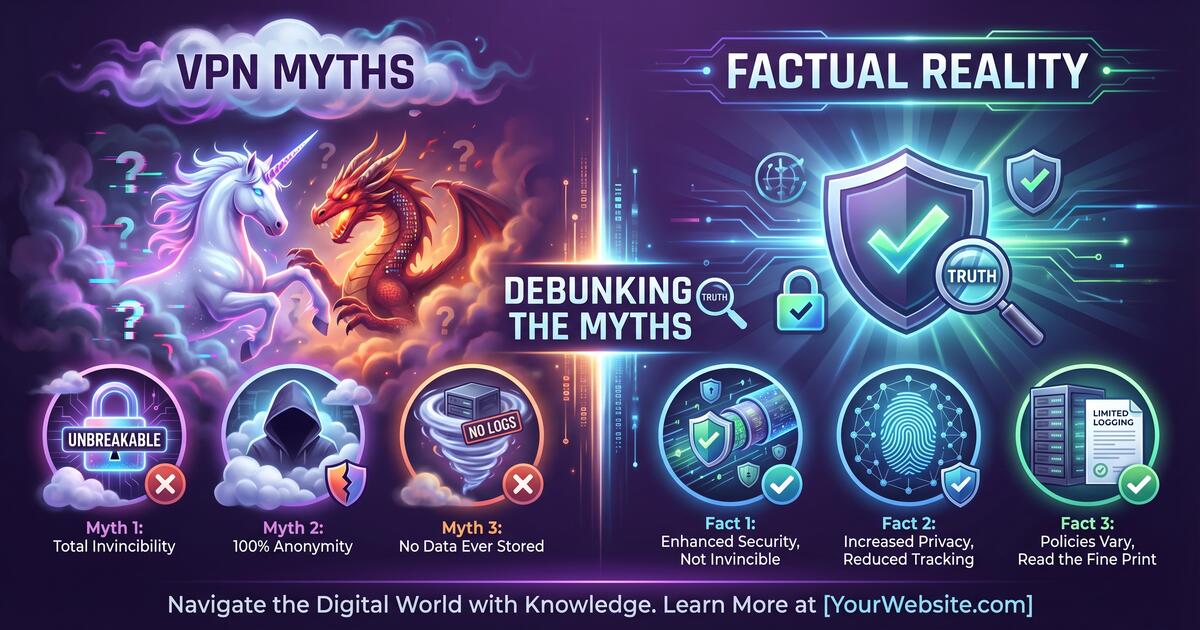
VPN myths are everywhere. Some people swear VPNs make you completely invisible. Others claim all free VPNs are identical scams. Meanwhile, some users believe VPNs slow down your internet or serve no purpose if you have "nothing to hide." The truth? Most VPN myths are half-truths at best—misunderstandings that can leave you less secure, not more. In this guide, we'll debunk the most common VPN myths and give you the real facts you need to make informed privacy decisions.
Why VPN Myths Matter
VPN myths aren't harmless misconceptions. When you believe false information about how VPNs work, you might:
- Overestimate your protection — thinking a VPN protects you from everything when it actually protects you from specific threats
- Skip essential security steps — relying solely on a VPN instead of using multi-layered security (password managers, two-factor authentication, antivirus software)
- Choose the wrong VPN — believing all VPNs are equal when quality varies dramatically
- Use VPNs incorrectly — misunderstanding limitations leads to ineffective or dangerous usage
- Miss genuine benefits — dismissing VPN protection entirely because one myth sounds ridiculous
The goal of this guide is simple: give you the honest truth so you can use VPNs effectively and understand exactly what they protect and what they don't.
Myth: VPNs Make You 100% Anonymous Online
Reality: VPNs enhance anonymity but don't guarantee it.
This is perhaps the most widespread VPN myth. Many users believe that connecting to a VPN instantly erases their digital footprint. The truth is more nuanced.
A VPN does hide your real IP address from websites and ISPs—that's true. But anonymity involves much more than just IP masking:
- Your browsing behavior still tracks you through cookies, browser fingerprinting, and user account logins. If you log into Facebook, Google, or Twitter, you're not anonymous.
- Your device identifiers (device ID, phone IMEI, browser fingerprints) can still identify you even with a VPN
- Your behavior patterns can be tracked across sites through advanced fingerprinting techniques
- Websites and apps can still see what you do once you're connected—they just don't see your IP
A VPN is one layer of privacy protection. It's effective against ISP tracking and public WiFi eavesdropping. But true anonymity requires additional steps: using private browsers, avoiding account logins, blocking cookies, and using anti-fingerprinting tools.
The Difference: Privacy vs. Anonymity
Privacy means others can't see what you're doing. A VPN provides privacy by hiding your IP and activity from ISPs. Anonymity means nobody can identify who you are. Achieving true anonymity requires much more—VPN + private browser + avoiding logins + anti-tracking tools.
Myth: VPNs Make You Invisible to Law Enforcement
Reality: VPNs hide your activity from ISPs but not from determined law enforcement.
Some users believe a VPN creates an impenetrable shield against all authorities. This myth often leads people to dangerous conclusions: "I can do illegal activities and never get caught with a VPN."
Here's the actual situation:
- VPNs hide your IP from ISPs and websites — law enforcement can't easily see what you're doing through your ISP
- But VPN providers have logs — if a VPN keeps connection logs or activity logs, law enforcement can subpoena those records
- VPN providers can be compelled — with a warrant, companies must cooperate with law enforcement requests
- Other evidence remains — your device still has metadata, timestamps, and other forensic evidence
- Payment records exist — you paid for the VPN, creating a financial trail linking you to the service
This is why transparency matters: Free VPN explicitly logs nothing about user activity. Many VPN providers claim "no-logs" but aren't transparent about what they actually keep. If you're concerned about privacy from authorities, choose a VPN provider that's been independently audited and keeps provably minimal logs.
Important Reality Check
VPNs are legal tools for legitimate privacy protection. Do not use a VPN to hide illegal activity. That's not what VPNs are designed for, and it won't actually protect you from law enforcement investigating serious crimes.
Myth: VPNs Always Slow Down Your Internet
Reality: VPN speed depends on server quality and server distance, not VPN technology itself.
Many users avoid VPNs because they assume they'll always experience slow, laggy connections. This myth often comes from using low-quality free VPNs with overloaded servers and poor infrastructure.
Here's what actually affects VPN speed:
- Server quality — professional VPNs invest in high-capacity servers and fast infrastructure. Budget VPNs cut corners with cheap, overcrowded servers.
- Physical distance — connecting to a VPN server far away adds latency. A local server will be faster than a distant one.
- Your base connection — a VPN can't make your connection faster than your ISP provides. It can only add minimal overhead.
- Encryption method — modern protocols like WireGuard are extremely fast with minimal overhead
- Competing users — a server with 1,000 users will be much slower than one with 50
Modern VPNs—including Free VPN—use advanced technologies that add minimal speed loss. In fact, many users experience better speeds with VPN enabled because their ISP throttles specific traffic types (streaming, torrenting). When you're on a VPN, the ISP can't see what you're doing, so it can't throttle you.
Pro Tip: Optimize Your VPN Speed
If you're experiencing slow speeds, try: (1) Connecting to a server geographically closer to you, (2) Switching VPN protocols (if your provider offers options like WireGuard), (3) Closing bandwidth-heavy applications, or (4) Restarting your VPN connection.
Myth: VPN Alone Protects You from All Threats
Reality: VPNs protect against specific threats but aren't a complete security solution.
This is a dangerous misconception: the belief that enabling a VPN makes you fully secure against all cyber threats. VPNs are excellent at what they do, but they have clear limitations.
A VPN protects you from:
- ISP tracking and monitoring
- Public WiFi eavesdropping
- Man-in-the-middle attacks on open networks
- Geolocation tracking from your IP
A VPN does NOT protect you from:
- Malware and ransomware (you need antivirus software)
- Phishing attacks (you need user awareness and email security)
- Weak or compromised passwords (you need a password manager and strong passwords)
- Account takeovers from credential stuffing (you need two-factor authentication)
- Tracking through behavioral analysis and fingerprinting
- Breaches on websites you use (even with a VPN)
Effective security requires multiple layers: VPN + strong passwords + 2FA + antivirus software + careful browsing habits. VPN is the foundation, not the entire house.
Myth: All Free VPNs Are the Same
Reality: Free VPNs vary dramatically in quality, security, and trustworthiness.
This myth works both ways: some users think "all free VPNs are scams" while others assume "any free VPN is as good as any other." The truth is different.
Why quality varies so much:
- Business model differences — some free VPNs are ad-supported, others sell user data, some are loss-leaders from companies making money elsewhere
- Infrastructure investment — maintaining global VPN servers costs millions. Some providers invest heavily; others cut corners catastrophically.
- Logging practices — some free VPNs log nothing; others log everything and sell the data
- Jurisdiction and regulation — VPNs registered in privacy-friendly jurisdictions have stronger legal protection for your data
- Security audits — some VPNs have been independently audited; others have never been reviewed
Not all free VPNs are trustworthy, but some—like Free VPN—are genuinely focused on providing privacy without monetizing your data. The key is choosing a provider with transparent practices, no-log policies, and proven credibility.
Evaluating a Free VPN Provider
Ask: Does the provider clearly state their logging practices? Have they been independently audited? Do they profit from selling user data? What's their jurisdiction? Do they have a track record of transparency? A trustworthy VPN provider answers these questions openly.
Myth: Using a VPN Is Illegal
Reality: VPNs are legal in most countries and serve legitimate privacy purposes.
Some users believe governments will arrest them for using a VPN. This myth is largely overblown, though with important nuances by country.
The legal landscape:
- Most countries: VPN use is completely legal. The US, Canada, most of Europe, and most of the world permit VPN use without restriction.
- Some countries restrict VPNs: A handful of countries (China, Russia, Iran, and a few others) restrict or ban unapproved VPN use, though enforcement varies.
- What matters is what you do: VPNs are legal tools. Using a VPN to hide illegal activity doesn't legalize the activity—it just adds deception to the crime.
- Legitimate purposes: VPNs are widely used for business (remote work, protecting corporate networks), privacy (personal security on public WiFi), and avoiding surveillance in oppressive regimes.
If you live in a country that restricts VPNs, be aware of local laws. For everyone else, VPN use is a normal, legal privacy practice—similar to using curtains on your windows.
Myth: You Don't Need a VPN If You Have Nothing to Hide
Reality: Privacy is a fundamental right, regardless of what you have to hide.
This is perhaps the oldest misconception about privacy: "If you have nothing to hide, you have nothing to fear." The "nothing to hide" argument misunderstands what privacy means.
Why privacy matters even for law-abiding people:
- Personal security — your browsing habits reveal medical conditions, financial struggles, relationship issues, and other sensitive information. Thieves and criminals use this data.
- Freedom of thought — knowing you're watched changes how you behave and what you research, even unconsciously (this is called "chilling effect")
- Corporate exploitation — ISPs sell your browsing data to advertisers and data brokers. Why should they profit from your information?
- Discriminatory targeting — data brokers use your information for discriminatory pricing, predatory advertising, and exclusion
- Mistaken identity — surveillance systems misidentify innocent people. Without privacy protections, you're vulnerable to mistakes affecting your life
- Government overreach — "nothing to hide" assumes governments never misuse power. History proves otherwise.
Privacy isn't about hiding criminal activity. It's about autonomy, dignity, and freedom from exploitation. You don't need to be breaking laws to benefit from a VPN—you just need to be human.
Key Takeaways
- VPNs enhance privacy but don't guarantee complete anonymity—other factors still matter
- While VPNs hide your IP and activity from ISPs, law enforcement can still subpoena VPN logs if they exist
- VPN speed depends on server quality and network conditions, not the VPN itself
- VPNs protect against specific threats (ISP tracking, public WiFi snooping) but not everything
- Free VPN quality varies drastically—choose trusted providers focused on security
- VPNs are legal in most countries and serve legitimate privacy and security purposes
- Everyone benefits from VPN protection regardless of 'nothing to hide'—privacy is a right, not a privilege
The Bottom Line: VPNs Are Powerful Tools, Not Magic
VPN myths persist because VPN technology is complex and powerful. That complexity creates space for misunderstanding. But the reality is straightforward: VPNs are excellent tools that solve specific, important problems. They hide your IP and browsing activity from your ISP and public WiFi attackers. They give you freedom to browse without ISP throttling. They protect your data on dangerous networks.
What VPNs don't do is solve every security and privacy problem. They're one layer in a comprehensive privacy and security strategy. Combined with strong passwords, two-factor authentication, antivirus software, and careful browsing practices, a good VPN significantly improves your digital security and privacy.
Now that you understand which VPN myths are real and which are misconceptions, you can make informed decisions about your privacy. And that's what matters: not blind faith in VPN technology, but understanding exactly what protects you and using that protection wisely.