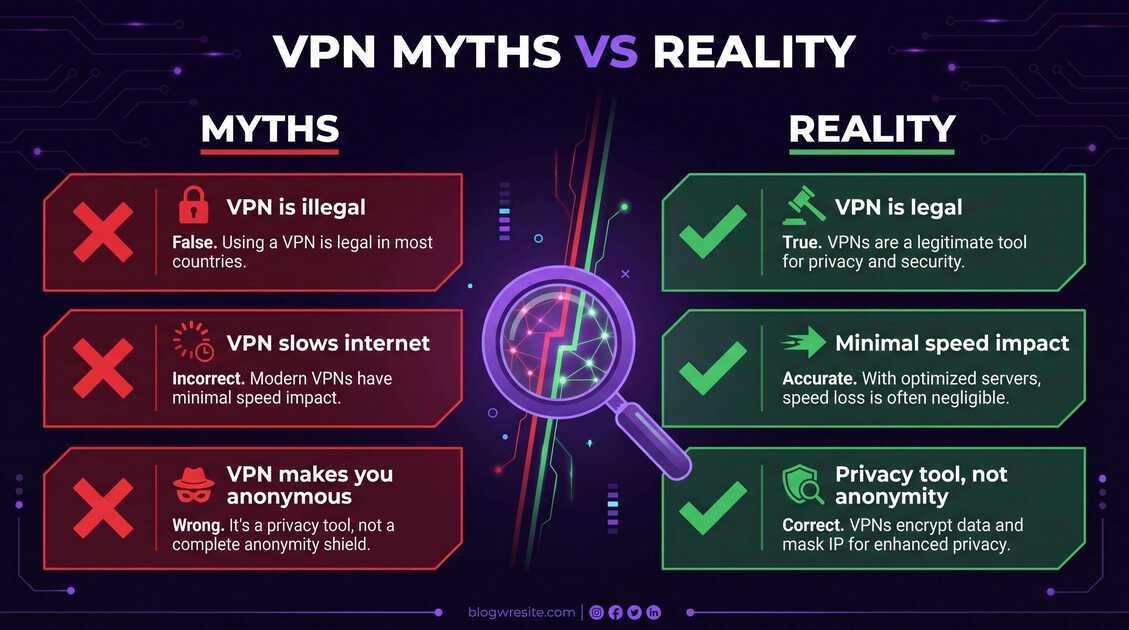
Virtual Private Networks have become essential tools for online privacy and security. Yet myths and misconceptions about VPNs persist, preventing millions from taking control of their digital safety. From "VPNs are illegal" to "VPNs will destroy your internet speed," these false beliefs spread through casual conversations and outdated information. In this guide, we'll debunk 10 of the most common VPN myths and reveal the truth about how VPNs actually work, what they protect, and why they matter for your privacy in 2026.
Why These Myths Matter
VPN misconceptions create real consequences. People skip VPN protection on public WiFi, believe they have no privacy rights at all, or assume their ISP can never see their activity. Others think VPNs are only for tech experts or people breaking laws. These myths cost people their privacy, expose them to targeted advertising, and leave them vulnerable to surveillance.
The truth is simpler than most myths suggest: VPNs are legal tools, they work effectively when chosen properly, and they protect fundamental aspects of your digital life. Let's clear the record straight.
Myth 1: Using a VPN is Illegal
This is perhaps the most persistent myth—and it's mostly false. VPNs are completely legal in most countries, including the United States, United Kingdom, Canada, Australia, and throughout the European Union. These regions recognize VPNs as legitimate privacy tools.
A few countries restrict or ban VPN use—primarily China, Russia, Iran, and the UAE—though VPN technology continues to evolve to operate in these regions. But if you're reading this from a Western democracy, using a VPN is entirely legal.
Important Distinction
Using a VPN is legal, but what you do through a VPN remains subject to the same laws. A VPN doesn't make illegal activity legal—it simply protects your ISP from seeing what you're doing.
Myth 2: VPNs Always Slow Your Connection
Many people believe VPNs will destroy their internet speed. The reality? A quality VPN typically slows your connection by only 5-15%, and sometimes doesn't noticeably affect speed at all. When you notice slowdowns, it's usually due to one of these factors:
- Poor VPN provider: Using a cheap or overcrowded VPN service with inadequate server infrastructure
- Server location: Connecting to a server far from your physical location adds latency
- Protocol choice: Some VPN protocols are faster than others (OpenVPN vs. WireGuard, for example)
- Encryption level: Stronger encryption takes slightly more processing power
Free VPN is optimized specifically to minimize speed loss. Our advanced server network and efficient protocols mean most users experience minimal impact on their browsing speed.
Myth 3: VPNs Give You Complete Anonymity
This myth overestimates what VPNs do. VPNs hide your IP address from websites and your ISP, but they don't make you invisible. Websites still see you—they just see the VPN server's IP instead of yours. Your VPN provider sees your connection.
Other ways you can be identified include:
- Browser fingerprinting: Your browser's unique characteristics can identify you across sites
- Login data: Logging into accounts reveals your identity to that service
- Cookies and tracking: Cross-site trackers can still follow your activity patterns
- DNS leaks: Improperly configured VPNs might leak your DNS queries
VPNs are privacy tools, not anonymity tools. They protect your IP and traffic from your ISP, which addresses the most common privacy threat most people face. Complete anonymity requires additional tools like Tor browser.
Myth 4: Free VPNs Are Worthless
People often say "you get what you pay for" regarding free VPNs. But free VPNs vary tremendously—some are genuinely excellent, while others are dangerously poor. The difference isn't about cost—it's about business model and architecture.
What Makes a Free VPN Work
Free VPNs funded by venture capital and built with user privacy as the core mission can be just as effective as paid options. Free VPN operates at scale with sustainable infrastructure because of our mission-driven approach to privacy protection.
What to avoid in free VPNs: services that sell your data to advertisers, inject ads into your traffic, or use outdated encryption. Legitimate free VPN services exist and work excellently—the key is choosing providers with verified privacy policies and transparent practices.
Myth 5: Using VPN for Streaming is Illegal
Accessing streaming services through a VPN isn't inherently illegal. Using a VPN itself is legal in most countries. However, individual streaming platforms have terms of service that may restrict VPN use for geographic content reasons.
The distinction matters:
- Legal: Using a VPN to connect to the internet is not breaking any law in most countries
- Terms of service violation: A streaming service might block your account if they detect VPN use, but this is a service policy, not a legal violation
Many people use VPNs with streaming platforms to access content available in their home country while traveling, which doesn't infringe on any copyrights—you're watching content you legally have access to through your subscription.
Myth 6: VPN Makes Hacking Impossible
VPNs provide strong protection against one specific type of attack: man-in-the-middle (MITM) attacks on public networks. But they're not armor against all cyber threats. VPNs don't protect you from:
- Malware: If you download a virus, a VPN won't stop it
- Phishing: You can click a phishing link through a VPN just as easily
- Weak passwords: VPN doesn't prevent account takeovers from brute-force attacks
- Unpatched software: Security vulnerabilities on your device aren't addressed by VPN
What VPN Actually Prevents
VPN specifically protects against ISP eavesdropping, WiFi sniffing attacks, DNS hijacking, and network-level packet capture. These are the threats most people face most frequently—which makes VPN enormously valuable as part of a layered security approach.
Myth 7: All VPNs Are the Same
This myth causes more poor choices than almost any other. VPNs differ dramatically in architecture, protocol, encryption, server networks, logging policies, and privacy practices. Some critical differences include:
- VPN protocol: OpenVPN, WireGuard, IKEv2, and others have different speed/security tradeoffs
- Encryption strength: 256-bit vs. 128-bit encryption (though 128-bit is still secure)
- Server infrastructure: Dedicated vs. shared servers, server count, and global distribution
- No-logs policy: Some providers log everything; others log nothing (and are independently audited)
- Jurisdiction: Where the VPN company is based affects what governments can demand
Choosing a VPN requires evaluating these factors against your actual needs, not just picking the cheapest or most popular option.
Myth 8: VPN Significantly Drains Battery
This myth has some truth in older technology but is largely outdated. Modern VPNs have minimal battery impact on mobile devices—typically 1-5% additional battery drain. Factors that affect battery usage:
- VPN protocol: Efficient protocols like WireGuard use less power than older protocols
- App optimization: Well-built VPN apps minimize background processing
- Connection stability: Constantly reconnecting drains battery; stable connections preserve it
- Encryption strength: Maximum encryption uses slightly more processor
For most users, the small battery impact is negligible compared to the privacy benefit. And you don't need to keep VPN running constantly—use it when you're on public WiFi or accessing sensitive information.
Myth 9: VPN Breaks Online Banking
Many people worry that banks won't work with VPNs. Actually, banks support VPN use because banks recognize VPNs improve security. In fact, many banks encourage remote access through VPN connections.
If you encounter banking issues with a VPN:
- The bank detected multiple locations in rapid succession (disconnect VPN before banking, then reconnect)
- Your VPN provider is on a fraud blacklist (rare with legitimate providers)
- Your bank requires you to disable VPN for specific transactions (switch to direct connection temporarily)
These are solvable problems. No reputable bank blocks VPN connections outright. If they did, they'd lose security-conscious customers. Banks actually prefer VPN-protected connections.
Myth 10: Governments Can't Block VPNs
This myth swings too far in the opposite direction. Some governments have successfully restricted VPN access—China and Russia have deployed sophisticated techniques to block common VPN protocols. However, VPN technology continuously evolves to maintain accessibility.
Current blocking methods include:
- Protocol blocking: Detecting and blocking known VPN protocols at the network level
- DPI (deep packet inspection): Analyzing traffic to identify VPN characteristics
- Port blocking: Blocking common VPN ports (443, 1194, etc.)
- Legal prohibition: Laws against VPN use with enforcement against VPN providers
But VPN providers respond with stealth protocols, obfuscation, and new techniques. Users in restricted countries often access VPNs through this ongoing innovation. The technology is never definitively "blocked"—it's an evolving challenge.
Key Takeaways
- VPNs are legal in most countries—using them responsibly is about protecting privacy, not breaking laws
- Quality VPNs don't slow your connection significantly; Free VPN is optimized for speed
- VPNs protect your ISP from seeing your traffic, but don't make you invisible to websites you visit
- Free VPNs like Free VPN work exceptionally well when built with privacy-first architecture
- Streaming platform access varies by location; VPN use is legal, but platform policies differ
- VPNs prevent man-in-the-middle attacks and ISP monitoring—they're crucial for security
- Different VPNs use different protocols, encryption, and server networks—quality matters
- Modern VPNs are optimized to minimize battery drain on mobile devices
- Banks support VPN use for security; any issues are solvable with proper VPN configuration
- Some governments restrict VPNs, but VPN technology continues to evolve to stay effective
Make Your Own Informed Decisions
VPN myths persist because misinformation spreads faster than corrections. But now you understand the reality: VPNs are legal privacy tools that work effectively, don't significantly slow your connection, and protect you from common digital threats—particularly ISP surveillance and WiFi eavesdropping.
The real question isn't whether VPNs work. They do. The question is: which VPN fits your actual needs? Free VPN provides everything you need for daily privacy protection with zero barriers to entry. No registration, no data collection, no ads—just genuine privacy protection.
Stop letting myths hold you back. Your privacy matters, and it's easier to protect than you've been told.