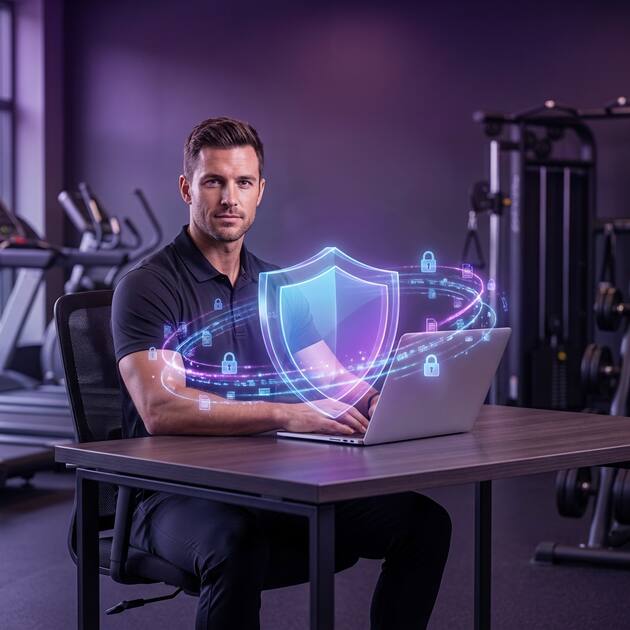
As a personal trainer or fitness coach, you handle sensitive information about your clients' bodies, health conditions, workout goals, and personal lives. You also face unique risks: fitness apps track your location constantly, clients may stalk or harass you through social media, and gym WiFi networks expose both your data and your clients' information. A VPN isn't just a nice-to-have privacy tool—it's essential infrastructure for protecting client confidentiality, securing fitness app data, and maintaining professional boundaries in an age of constant digital surveillance.
Why Personal Trainers Face Unique Privacy Risks
Personal trainers and fitness coaches occupy a unique position at the intersection of health, business, and personal relationships. Unlike healthcare providers with regulatory frameworks, fitness professionals often operate in a gray zone where privacy expectations are unclear—yet the stakes are high.
Client trust and intimacy create privacy obligations. Clients share their insecurities, body image struggles, medical conditions, and personal life circumstances with you. They assume this information stays private. A breach isn't just a data incident—it's a violation of trust that can end your career and harm vulnerable clients.
You're a targeting vector for harassment. Fitness professionals are highly visible on social media. Your name, location, gym affiliation, and client list are often public information. Disgruntled clients, obsessed individuals, or coordinated groups can use this information to stalk, harass, or attempt to doxx you. Female trainers and coaches face disproportionate risks of sexual harassment and stalking.
Fitness apps are constant location trackers. Strava, Apple Health, Google Fit, and similar apps not only track your workouts—they create public heat maps showing your exact routes and timing. Malicious actors can use this to predict where you'll be and when. Clients can identify your gym location or home address by analyzing your activity patterns.
Gym networks are security nightmares. Most gym WiFi networks are unencrypted, shared, and monitored by gym staff or third parties. Any data you or your clients transmit—passwords, payment information, personal messages, fitness app connections—is vulnerable to interception.
Critical Risk: Clients May Stalk or Harass You
Fitness professionals regularly experience obsession, romantic rejection, and even violent threats from clients. Location data from fitness apps, combined with your social media presence, makes you extremely vulnerable to stalking. A VPN masks your location trails, but comprehensive safety planning requires additional layers beyond just VPN protection.
Client Data & Confidentiality Obligations
While fitness coaches aren't bound by HIPAA like healthcare providers, you still have professional and ethical obligations to protect client confidentiality. Many clients view their fitness goals and body information as highly sensitive personal data.
What confidential client data do you handle? Client files typically include body measurements (weight, body fat %, measurements), fitness goals and timelines, medical history and injuries, medications and health conditions, dietary information and restrictions, payment and billing information, contact details and emergency contacts, and personal goals and motivations.
Breaches harm clients directly. If a client's confidential measurements or health information is exposed, they may face embarrassment, discrimination, or social harm. If their payment information is stolen, they face financial and identity theft risks. Some clients may be in abusive relationships where an ex-partner could use fitness information to locate or harm them.
Professional standards expect confidentiality. Organizations like ISSA (International Sports Sciences Association) and NASM (National Academy of Sports Medicine) include confidentiality in their professional standards. Industry best practices recognize that client information should be handled with the same care as healthcare data.
Transmitting or storing client data over unencrypted connections—such as through an unprotected gym WiFi network when you're accessing your client management app—violates this professional responsibility.
Fitness App & Device Tracking Risks
Fitness apps are engineered to collect comprehensive location, health, and behavioral data. While some of this data collection is necessary for the app's core function, much of it is used for targeted advertising, data brokerage, and behavioral profiling.
Location tracking is granular and permanent. Apps like Strava create detailed maps of everywhere you run, walk, or cycle. These maps are publicly searchable by default. Your route home from the gym reveals your home address. Your consistent gym schedule reveals exactly when you're away from home. Strava has been criticized for revealing sensitive military bases and allowing people to identify and locate runners.
Fitness apps transmit unencrypted data. When your fitness app syncs to the cloud, it's sending location, heart rate, sleep data, calorie burn, and other sensitive health information. Without a VPN, this data travels unencrypted over gym WiFi and cellular networks, vulnerable to interception by anyone on the same network.
App integrations create data multiplication. When you connect fitness apps to social media, Apple Health, Google Fit, or other services, your data spreads across multiple platforms. A breach at any single integration point exposes comprehensive health profiles to hackers, data brokers, and advertisers.
Wearable devices are location beacons. Apple Watches, Fitbits, and Garmin devices constantly communicate with cloud servers. These devices can be reverse-engineered to reveal location, identity, and behavior patterns. Insurance companies, employers, and malicious actors have all attempted to access this data for profiling and discrimination.
Location Exposure & Physical Safety Risks
Location privacy is critical for physical safety. For personal trainers, location exposure creates multiple vectors of risk.
Your gym location can be identified from fitness data. Strava heat maps make it trivially easy to identify which gym you work at. A stalker can cross-reference your fitness app locations with your social media photos to identify your exact gym location, your workout times, and your routes to and from work.
Home address exposure is one query away. Your gym location, combined with public records or simple social engineering, can reveal your home address. Clients, former lovers, or hostile individuals can physically show up at your home or intercept you during your commute.
Abusive client situations escalate to physical danger. Some clients develop obsessive attachments or become hostile when they don't achieve results or when they're rejected. Location data makes it easy for them to show up at your home, workplace, or places you frequent. Having your location masked by a VPN is an important security layer.
Travel and schedule patterns reveal vulnerability windows. Fitness apps that track your workouts also reveal when you're away from home, when you travel, and when you're vulnerable. This information is valuable to thieves planning break-ins and to stalkers planning confrontations.
Data Broker Risk
Your fitness app data doesn't stay with the app company. Data brokers buy location and behavior data from app publishers, creating comprehensive profiles of millions of people. Insurance companies, employers, law enforcement, and private investigators can purchase this data to track you, profile you, and make decisions about you without your knowledge.
Client Harassment, Doxxing & Privacy Invasion
Personal trainers and fitness coaches are highly visible on social media. Instagram and TikTok are where fitness professionals build their audience and grow their business. But this visibility creates harassment and doxxing risks.
Obsessive or rejected clients can turn hostile. A client who develops an unrequited attraction, feels you didn't deliver results, or is angry about a business decision can easily escalate to harassment. They may post hateful comments on your social media, share private conversations, or attempt to turn your audience against you.
Doxxing combines public data into a targeting package. Your social media photos show your face and gym location. Your gym website lists your phone number. Your name on Strava reveals your typical routes. A stalker can combine these pieces into a comprehensive package that enables harassment, intimidation, or worse.
Female trainers face gender-specific harassment. Studies show that female fitness professionals experience higher rates of sexual harassment, unwanted advances, and misogynistic attacks on social media. Attackers often attempt to shame women trainers as "fake," "unattractive," or unqualified, using personal information to maximize humiliation.
Payment processor information can be exposed. If you use Venmo, PayPal, or other payment apps where transaction history is sometimes public, clients can see your transaction patterns. Reverse lookups can identify who you're receiving money from, potentially revealing other clients or professional relationships.
While a VPN can't stop someone from being obsessed with you, it can prevent them from using location tracking and IP-based research to identify and locate you.
Gym Network & Workplace Surveillance
Gym WiFi networks are notoriously insecure. But they're not the only surveillance threat in gym environments.
Gym WiFi is shared, unencrypted, and monitored. Almost all gym WiFi networks are public, unencrypted networks. Anyone on the network can intercept data transmitted by anyone else. Gym staff, trainers, and even other members can passively monitor what you're doing on your phone or laptop. Some gyms use network monitoring software to track member activity and staff behavior.
Guest networks isolate you, but aren't secure. Many gyms have "guest" networks separate from staff networks. But guest networks are still unencrypted and shared. A VPN is essential for any data transmission over gym WiFi.
Gym staff may monitor or log your activity. Depending on the gym's policies, staff may have access to network logs showing which websites you visit, which apps you use, and which services you access. This is a privacy concern even if staff don't actively monitor individual trainers.
Client devices are also vulnerable on gym WiFi. When your clients connect to gym WiFi, their devices—and any data they transmit—are vulnerable to the same interception and monitoring risks. If you're communicating with clients over unencrypted channels on gym WiFi, you're exposing their data to interception.
Home networks are often weak. If you work with clients from home (virtual training, consultations, program development), your home WiFi security is critical. Many home routers have default passwords, weak encryption, or outdated firmware. A VPN encrypts all data leaving your home network, regardless of router security.
Online Harassment & Social Media Risks
Personal trainers build their business through social media. But social media also creates harassment and safety risks.
Your IP address reveals your location. Instagram, TikTok, LinkedIn, and other platforms log your IP address. If someone knows your IP, they can identify your city, and sometimes your neighborhood. Reverse IP lookups can reveal your internet service provider, and sometimes additional details. A VPN masks your IP address, preventing location identification through IP tracking.
Location metadata in photos is often public. If you upload photos without stripping metadata, the EXIF data in the image file may contain GPS coordinates of where the photo was taken. This can reveal your exact gym location, home address, or current location. Even if you strip EXIF data, people can identify locations from visual landmarks in photos.
Fake accounts and catfishing enable harassment. Stalkers and harassers often create multiple fake accounts to contact you, gather information, or coordinate harassment campaigns. These accounts may appear to be potential clients, but are actually attempts to gain access to your location, schedule, or personal information.
Screenshot sharing and revenge tactics. A disgruntled client can screenshot private messages or take screenshots of content you've shared, then share these widely out of context to damage your reputation or recruit others to harass you.
A VPN helps by masking your IP and making it harder for people to identify and track your location through IP-based research. Combined with careful social media practices, it's an important layer in a comprehensive harassment prevention strategy.
How VPN Protects Personal Trainers & Coaches
A VPN protects trainers and coaches through several mechanisms, each addressing a different threat vector.
1. Encrypts fitness app data transmission. When you connect to a VPN before opening fitness apps or accessing fitness tracking websites, all data transmitted to those services is encrypted. Even if someone is monitoring the gym WiFi network, they can't see your location data, heart rate data, or other fitness metrics. The data tunnel between your device and the VPN server is invisible to network eavesdroppers.
2. Masks your IP address on gym networks. Your IP address is your digital identity. Websites and services can use it to identify your location, log your activities, and track your behavior across sessions. A VPN replaces your real IP with the VPN server's IP. This prevents gym websites, fitness apps, and other services from identifying your location or tracking your behavior on the gym network.
3. Prevents location tracking via WiFi fingerprinting. Even without explicit location permission, devices can be identified by WiFi network names and signal strengths. Attackers can use WiFi fingerprinting to track you across locations. A VPN encrypts your WiFi traffic, preventing this type of location inference.
4. Hides your online activity from gym staff and network monitors. If your gym has network monitoring software, a VPN encrypts your traffic so that monitors can only see that you're using a VPN—they can't see which websites you visit, which apps you use, or what data you transmit. This protects your privacy from gym management and staff.
5. Protects public WiFi security at other locations. You're not always at the gym. When you're at coffee shops, hotels, airports, or other public locations with unencrypted WiFi, a VPN provides the same encryption and IP masking protection. Free VPN's auto-connect feature can automatically protect you whenever you connect to an open WiFi network.
Important limitation: A VPN doesn't protect fitness app data once it's stored on the app's servers. If the fitness app itself is breached, the app company has your location data and health metrics. A VPN only protects data in transit. For fitness app security, also change app permissions to limit location access, disable public sharing features, and regularly review what data apps collect.
Pro Tip: VPN First, Then App
The best practice is to connect to a VPN BEFORE opening any fitness apps or accessing gym networks. This ensures that all data the app transmits is encrypted from the moment your device connects to the network. Many VPNs offer auto-connect features that automatically protect your connection whenever you join open WiFi networks, making this effortless.
Building a Comprehensive Privacy Strategy
A VPN is essential, but it's only one layer of a comprehensive privacy protection strategy. Protecting client data and your personal privacy requires a multi-layer approach.
Layer 1: Network encryption (VPN). Use a VPN whenever you access gym networks, client management apps, or fitness apps. A VPN encrypts all data transmission, preventing interception and location tracking at the network level.
Layer 2: Device security. Keep your phone and computer updated with the latest security patches. Use strong passwords and biometric authentication. Enable 2FA on all important accounts (email, payment processors, social media). Regularly review app permissions and revoke access to location data for apps that don't need it.
Layer 3: Data handling procedures. Store client data securely. Use password-protected, encrypted storage for client files. Don't leave client records visible on shared screens or in areas where other people can see them. Use separate devices or accounts for client work vs. personal use when possible.
Layer 4: Communication security. Use encrypted messaging apps (Signal, iMessage) for sensitive client communication instead of SMS or email. Avoid transmitting confidential information through unencrypted channels. Encourage clients to use secure communication methods.
Layer 5: Location privacy management. Disable location sharing on Strava and other fitness apps, or use private accounts with limited followers. Regularly review what data is being collected by fitness apps and disable collection for apps you don't actively use. Don't post location-specific details (gym name, address, routes) in social media captions. Use general locations rather than specific addresses.
Layer 6: Professional boundaries and social media safety. Keep professional and personal social media separate when possible. Don't accept friend requests from clients or unclear individuals. Regularly review who has access to your location data through social media check-ins. Be cautious about accepting payments through payment apps where transaction history is public.
Key Takeaways
- Personal trainers handle sensitive client health data (body measurements, medical conditions, lifestyle info) with privacy expectations
- Fitness apps constantly track location, workout patterns, and health metrics—exposing trainers and clients to surveillance
- Clients may stalk, harass, or attempt to doxx trainers through social media, payment processors, and publicly available data
- Gym WiFi networks and shared devices create security vulnerabilities for both client data and trainer information
- VPN encryption protects fitness app data transmission, masks your location, and establishes a privacy boundary between professional and personal life
- A comprehensive privacy strategy requires 6 layers: network encryption, device security, data handling procedures, communication privacy, location awareness, and professional boundaries
Protecting Client Privacy and Your Reputation Is Your Professional Responsibility
Personal training is built on trust. Clients trust you with their bodies, their insecurities, their medical information, and their personal stories. Protecting that trust isn't just the right thing to do—it's essential to your long-term success and reputation as a coach.
Client confidentiality and privacy protection should be fundamental to how you operate. Using a VPN on gym networks and public WiFi is a practical, simple step that demonstrates your commitment to protecting client data and your own professional security.
Privacy protection also protects you. Masking your location prevents stalkers and obsessed clients from tracking you. Securing your communications prevents harassment. Protecting client data prevents breaches that could tank your reputation and end your career.
Start today: download Free VPN, enable auto-connect, and protect all your gym WiFi activity. Your clients' privacy and your safety depend on it.