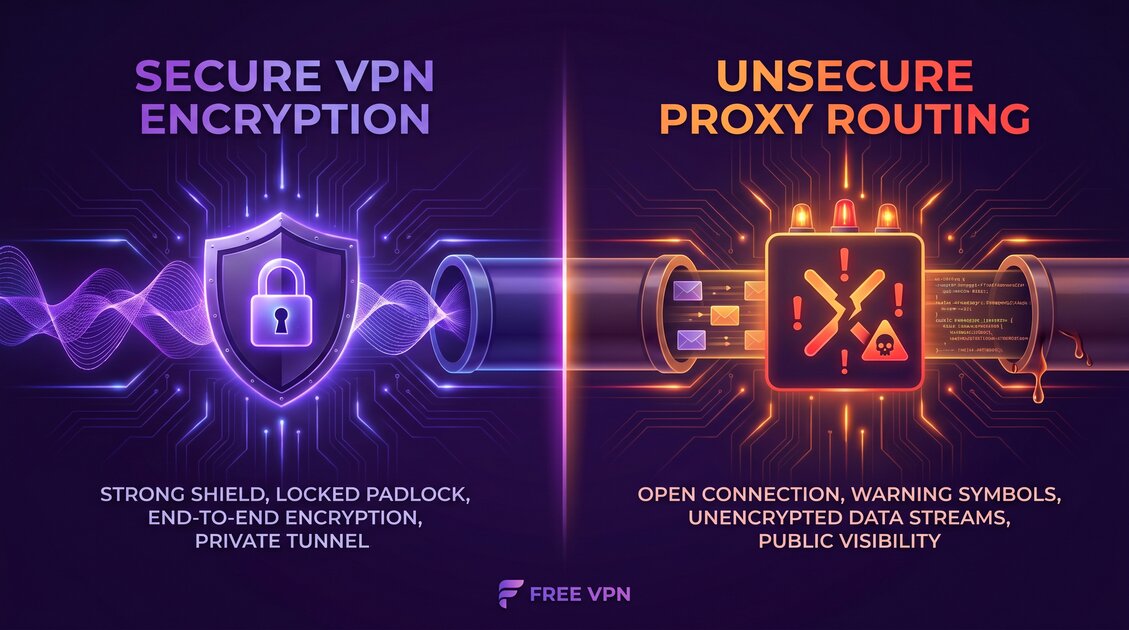
When it comes to protecting your online privacy, the choice between a VPN and a proxy is one of the most important decisions you'll make. Both tools hide your IP address, but they work in very different ways—and one offers dramatically better privacy protection than the other. Understanding these differences could be the difference between staying truly safe online and thinking you're protected while actually being exposed.
What is a Proxy?
A proxy server is an intermediary server that sits between your device and the websites you visit. When you access a website through a proxy, the website sees the proxy's IP address instead of yours. It's like using someone else's mailbox to send letters—the recipient sees the mailbox address, not yours.
Proxies come in several types:
- HTTP/HTTPS proxies: These work only with web browsers and handle HTTP/HTTPS traffic only.
- SOCKS proxies: These are more versatile and can handle various types of traffic, including P2P applications.
- Residential proxies: These use real residential IP addresses, making them harder to detect and block.
The key limitation: proxies route your traffic but don't encrypt it. Your Internet Service Provider (ISP), network administrators, and anyone monitoring your connection can still see exactly what you're doing online—they just see the proxy's IP instead of yours.
What is a VPN?
A VPN (Virtual Private Network) does much more than mask your IP address. It creates an encrypted tunnel between your device and the VPN server. All your internet traffic—not just web browsing, but email, messages, app activity, everything—passes through this encrypted tunnel.
When you use a VPN:
- Your ISP sees that you're using a VPN but can't see what you're doing
- Websites see the VPN server's IP address, not yours
- Your connection is protected with military-grade encryption
- All your apps and devices connected to the VPN are protected
Unlike proxies, VPNs protect your entire internet connection, not just your browser traffic. This is a fundamental difference that makes VPNs far more comprehensive.
Key Differences Between VPN and Proxy
Let's break down the major distinctions:
Encryption
This is the biggest difference. VPNs encrypt your entire connection with strong encryption (typically 256-bit AES). Proxies do not encrypt anything. Your data travels in plain text through the proxy, making it vulnerable to interception by anyone on the network or at the proxy server.
Scope of Protection
A proxy protects only your browser traffic (and only if it's an HTTP proxy) or specific applications (SOCKS proxy). A VPN protects all applications on your device—your browser, email client, messaging apps, streaming services, online games, everything.
Speed Impact
Proxies are generally faster because they don't encrypt your traffic. VPNs may have a slight speed reduction due to encryption overhead, though modern VPNs like Free VPN are optimized to minimize this.
Ease of Use
Proxies often require manual configuration for each application. VPNs are typically installed once and protect everything automatically. Free VPN, for example, works with one tap—no app-by-app configuration needed.
Cost
Many proxies are free, but free proxies are often slow and untrustworthy. Quality VPNs may have a cost, though Free VPN offers complete protection at no cost.
Did You Know?
Many free proxies sell your data to advertisers or cybercriminals. When the service is free, you're often the product. Free VPN, by contrast, makes its money from premium features—your privacy is never for sale.
Privacy Protection: VPN vs Proxy
This is where the gap widens significantly. Let's look at specific threats:
ISP Monitoring
Proxy: Your ISP can see everything you do, including the websites you visit, the files you download, and the time you spend on each site.
VPN: Your ISP sees only that you're using a VPN. They cannot see your activity.
Public WiFi Security
Proxy: On public WiFi, hackers can intercept your unencrypted data even if you're using a proxy. Your data is visible to anyone with basic hacking tools.
VPN: On public WiFi, your data is protected with encryption. Hackers cannot read your passwords, messages, or banking information.
Website Tracking
Proxy: The websites you visit see the proxy's IP but can still track you through cookies, browser fingerprinting, and other methods. Your real location can often be determined through geolocation data.
VPN: Websites see the VPN server's location, masking your real location. Combined with Free VPN's other privacy features, tracking becomes much harder.
Data Broker Exposure
Proxy: Your real IP address is still exposed in many ways—through DNS requests, WebRTC leaks, and other mechanisms. Data brokers can piece together your identity.
VPN: A properly configured VPN prevents these leaks and keeps your real identity private.
Important Warning
Never trust an unencrypted proxy for sensitive activities like online banking, email access, or shopping. The lack of encryption means your passwords and financial information could be intercepted by hackers or the proxy provider itself.
Speed & Performance Comparison
One common misconception is that proxies are always faster. This isn't entirely true:
Proxy Speed
Proxies can be faster because they don't use encryption. However, many free proxies are slow due to high user loads and poor infrastructure. Quality matters.
VPN Speed
Modern VPNs like Free VPN are highly optimized. The encryption overhead is minimal—usually 5-15% slower than an unencrypted connection. The speed difference is often imperceptible to users, especially on high-speed connections. Free VPN's Accelerate feature actually boosts speeds up to 10x through intelligent routing optimization.
Practical Impact
For most activities—browsing, streaming, video calls, gaming—the difference in speed is negligible. The security benefit of a VPN far outweighs any minor speed difference.
When to Use VPN vs Proxy
Use a Proxy When:
- You need to bypass a geographic restriction on a specific website (though VPNs do this too, with better security)
- You're testing website functionality from different locations
- You want minimal speed impact for unencrypted, non-sensitive browsing
- Speed is absolutely critical and privacy is less of a concern
Use a VPN When:
- You're on public WiFi (absolutely critical)
- You want comprehensive privacy protection for all your apps
- You're handling sensitive information (banking, passwords, health data)
- You want protection from ISP tracking and monitoring
- You're traveling internationally and want consistent protection
- You care about your privacy as a fundamental right (which should be always)
Pro Tip
Free VPN users often discover they can do everything they would use a proxy for—unblock geo-restricted content, access services from different locations—but with complete encryption and privacy protection. In 2026, there's really no reason to compromise on privacy when a VPN does it all better.
Key Takeaways
- Proxies route your traffic but don't encrypt it; VPNs encrypt your entire connection
- VPNs provide superior privacy protection from ISPs, hackers, and data brokers
- Proxies may offer slightly faster speeds but leave you vulnerable to surveillance
- VPNs protect all your devices and apps; proxies only work for specific browsers or apps
- For real privacy in 2026, a VPN like Free VPN is the only truly secure choice
- Proxies have legitimate uses (bypassing geo-blocks) but should never replace VPN protection
Which Should You Choose?
The answer is clear: for real privacy protection in 2026, a VPN is the only choice that makes sense. Free VPN offers what you need:
- Complete encryption with military-grade 256-bit AES protection
- Universal coverage for all apps and devices on your connection
- No registration required to get started
- Lightning-fast speeds optimized with our Accelerate feature
- Zero logging of your activity or personal data
Proxies have their place, but they're not a genuine privacy solution. They're like locking your front door while leaving your windows open—it creates an illusion of security without real protection. A VPN closes all the windows and locks all the doors.
Your privacy is too important to compromise. Protect yourself with a real VPN that delivers genuine encryption, complete app coverage, and zero logging. That's the only way to stay truly safe online in 2026.