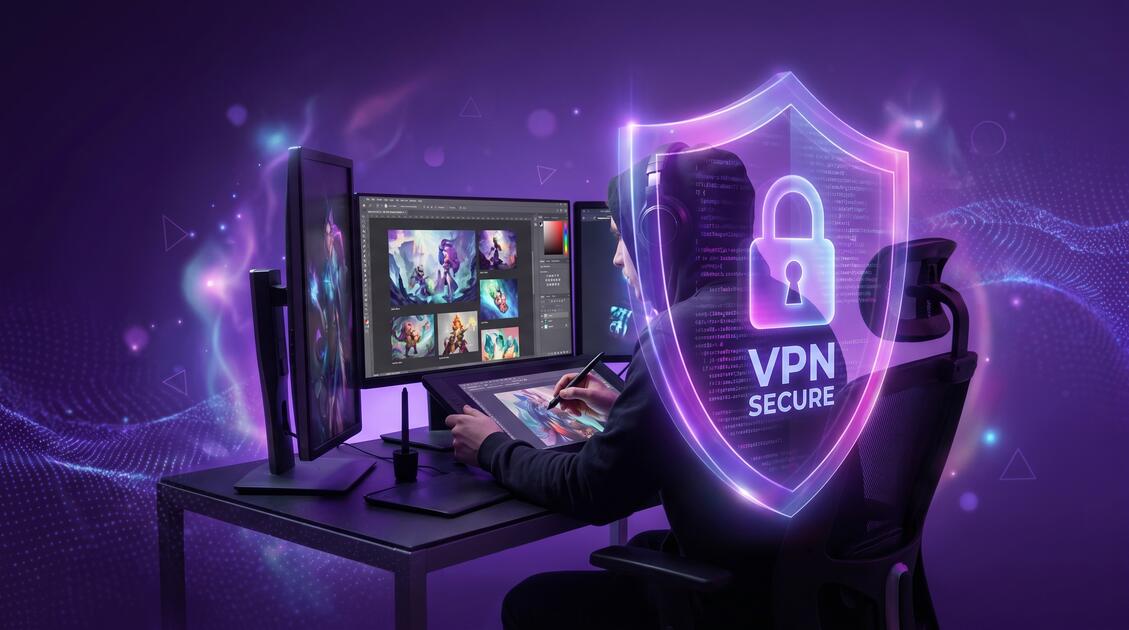
Your art is your livelihood. Whether you're a graphic designer, illustrator, photographer, or digital creator, your portfolio represents years of creativity, skill development, and original work. But in 2026, your creative work faces threats you may not even know about—from AI companies scraping your portfolio without permission to bad actors stealing your designs and passing them off as their own. This comprehensive guide shows you how to protect your creative work, your portfolio, and your intellectual property using a VPN and other critical security measures.
The Real Threats to Your Creative Work
Artists and creative professionals face unique security challenges online. Your portfolio isn't just a collection of pretty pictures—it's proof of your skills, your unique artistic voice, and the foundation of your career and income.
Unfortunately, several serious threats put your creative work at risk:
- Portfolio scraping: Bots automatically download every image from your portfolio, potentially re-uploading them to other sites or using them for unauthorized purposes
- AI training without consent: Large AI image models are trained on millions of copyrighted artworks—often without artist permission or compensation
- Identity theft: Attackers can hijack your email or social accounts to impersonate you and post fake work
- Design theft: Competitors or bad actors steal your designs and claim them as original work
- Doxxing: Your real location and personal information can be exposed, leading to harassment or physical threats
- Counterfeit sales: Criminals sell unauthorized prints or merchandise featuring your original art
WARNING: AI Companies Are Already Scraping Art
Major AI image generators have trained their models on billions of copyrighted artworks, often without artist permission. Recent lawsuits confirm that artists' portfolios were included in these datasets. Your current portfolio may already be part of an AI training set.
AI Scraping & Unauthorized Training
One of the most pressing threats artists face in 2026 is having their work used to train AI image generation models. Companies like Midjourney, DALL-E, and Stability AI built their models by training on publicly available images—including millions of copyrighted artworks scraped from artist portfolios.
When AI companies scrape your portfolio:
- They use your unique artistic style to generate similar images for paying customers
- You receive no credit, payment, or consent
- Your original work can be used to train models that directly compete with you
- The trained AI model can generate endless variations that mimic your style
While you can't prevent AI companies from accessing publicly available portfolios entirely, VPN and other security measures make it significantly harder for scrapers to target your specific work systematically.
Did You Know?
Recent class-action lawsuits against AI companies prove that artist portfolios were deliberately included in training datasets. Multiple artists are seeking compensation for unauthorized use of their work.
Portfolio Scraping & Content Theft
Beyond AI training, portfolio scraping poses immediate, practical threats to your business. Bad actors use automated bots to download thousands of images from your portfolio, then:
- Re-upload to other platforms: Post your work on competitor sites, stock photo sites, or even sell it as their own
- Create counterfeit merchandise: Print your designs on t-shirts, mugs, and posters without permission
- Plagiarize your work: Claim your designs as original creations to land freelance contracts or agency jobs
- Reverse engineer your style: Use your downloaded portfolio to train internal models or study your techniques
- Monitor your location: Your IP address reveals your approximate location, which unethical competitors can use to target you or worse
Portfolio scraping typically happens when your portfolio is public (which it needs to be for clients to find you). The challenge is preventing bad actors from abusing open access to download your entire body of work.
How VPN Protects Your Creative Work
While VPN isn't a complete solution (you still need watermarks, copyright metadata, and legal protections), it's a critical part of your defense strategy:
1. Mask Your IP Address & Location
Your real IP address reveals your approximate geographic location. When you upload work to your portfolio without VPN, scrapers and attackers can identify where you're located, potentially enabling physical threats, doxxing, or targeted attacks. Free VPN masks your IP address, making it significantly harder for bad actors to identify your physical location while you manage and upload creative work.
2. Prevent Targeted Scraping Campaigns
Automated scraping bots typically target portfolios by attempting to access your site from a single IP address repeatedly. When the site detects repeated access from the same IP, it can block that access. VPN helps by rotating your IP address—if you need to access your portfolio to make updates, VPN ensures those accesses come from different IP addresses, reducing the appearance of automated scraping patterns.
3. Secure Your Admin Access
When you log into your portfolio to upload new work, update descriptions, or manage client communications, VPN encrypts that connection. Without VPN, attackers on your network (at a coffee shop, coworking space, or public WiFi) could potentially intercept your login credentials, email messages, or file transfers. VPN prevents this by encrypting all traffic between your device and the portfolio server.
4. Protect Sensitive Metadata
Your portfolio uploads often include metadata—information embedded in image files including creation date, location data, and sometimes camera information. VPN prevents ISPs and network administrators from intercepting and analyzing this metadata while you upload files.
Pro Tip: Use VPN Whenever Managing Your Portfolio
Enable Free VPN Auto-Connect before logging into your portfolio, uploading new work, or accessing client communications. This ensures your IP address is masked and your uploads are encrypted, even on your home network.
Security Best Practices for Artists
VPN is part of a comprehensive security strategy for protecting your creative work. Combine VPN with these essential practices:
Digital Watermarks & Copyright Metadata
Every image file should include visible watermarks and embedded copyright metadata (EXIF data). This discourages casual theft and provides legal proof of your ownership. Most image software allows you to embed metadata automatically when you export files.
Portfolio Rights & Legal Protections
- Review platform terms: Understand your rights on sites like Behance, Dribbble, ArtStation, and personal portfolio platforms. Some platforms claim ownership of your work—choose wisely
- Use copyright notices: Display "© [Your Name] [Year]. All Rights Reserved." prominently on your portfolio
- Include licensing information: Specify whether your work can be used commercially or requires licensing
- Register your copyrights: In the US and many countries, register significant works with copyright offices for legal protection
Secure Your Accounts & Communications
- Use unique, strong passwords for every platform (store them in a password manager encrypted with VPN)
- Enable two-factor authentication on all art platforms and email accounts
- Use VPN when accessing portfolio platforms from public WiFi
- Keep software, browsers, and apps updated to patch security vulnerabilities
Monitor for Unauthorized Use
Regularly search for your work online using image search engines (Google Images, TinEye, Bing). Set up Google Alerts for your name and notable project names. When you find unauthorized use, document it and take action (DMCA takedown notices, cease-and-desist letters, platform reporting).
Limit Portfolio Exposure
Consider strategies like:
- Showing selected portfolio pieces rather than everything you've ever created
- Using lower-resolution preview images on your public portfolio with higher-resolution access limited to authenticated clients
- Adding robots.txt rules to prevent automated scraping (though this doesn't stop determined bad actors)
- Rotating featured work periodically so your entire portfolio isn't continuously available in one place
Key Takeaways
- AI companies are actively scraping artist portfolios to train models without consent or compensation
- VPN prevents unauthorized access to your portfolio and makes it harder for scraping bots to target your work
- Portfolio IP addresses can be tracked, and physical locations can be identified—VPN masks this information
- Use VPN when uploading, managing, and sharing your creative work online
- Combine VPN with digital watermarks, copyright metadata, and licensing agreements for comprehensive protection
- Never trust third-party portfolio platforms without reviewing their data usage policies
Protect Your Creative Work in 2026
Your creative work is valuable—it represents your talent, time, and expertise. In an era of AI scraping, portfolio theft, and digital harassment, protecting your art is essential. VPN is a critical tool in your security toolkit, protecting your location, encrypting your uploads, and making it harder for bad actors to target your work systematically.
Use Free VPN Auto-Connect whenever you manage your portfolio, upload new work, or communicate with clients. Combine VPN with watermarks, copyright metadata, strong passwords, two-factor authentication, and legal protections. Monitor your work online regularly and take action against unauthorized use.
Your art deserves protection. Start protecting it today.