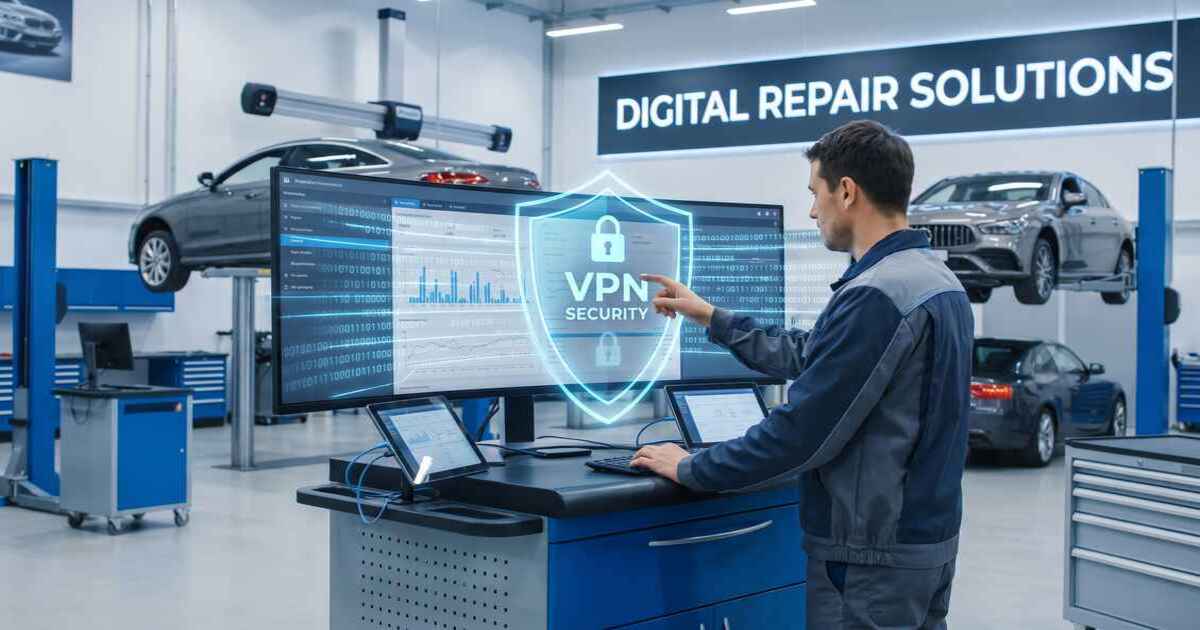
Automotive repair shops and dealerships are facing a crisis. Every diagnostic scan, service record, and customer interaction generates valuable data—information that cyber criminals are increasingly targeting through ransomware, credential theft, and sophisticated double-extortion schemes. Unlike corporate IT environments with dedicated security teams, most auto shops operate with minimal cybersecurity infrastructure, making them vulnerable to devastating attacks that can shut down operations overnight.
Why Are Automotive Shops So Vulnerable?
Automotive businesses occupy a unique cybersecurity blind spot. Shop owners are expert mechanics and technicians—not security specialists. Their focus is on service quality and customer satisfaction, not network defense. This combination creates perfect conditions for cyber attackers:
- Limited IT budgets: Auto shops allocate only 2-5% of revenue to technology, leaving security underfunded and outdated
- Mobile access patterns: Mechanics access diagnostic systems from multiple locations (shop floor, customer vehicles, parking lots) often on public WiFi or mobile networks
- Legacy systems: Service management software often runs on older platforms with unpatched vulnerabilities
- Complex supply chains: Third-party integrations with parts suppliers, insurance companies, and diagnostic platforms create multiple attack vectors
- Employee turnover: High staff turnover means dormant credentials and inconsistent security practices
- Business continuity pressure: Every minute of downtime means zero revenue—shops literally cannot operate without their diagnostic and service systems
Ultra-Sensitive Vehicle & Customer Data at Risk
The data handled by automotive shops is extraordinarily valuable to criminals. Here's what's at risk in every service:
- Vehicle Identification Numbers (VINs): Worth $50-500+ per vehicle on dark web markets. Criminals use VINs for vehicle cloning, title fraud, and odometer manipulation
- Service records: Complete maintenance history, repair costs, and parts ordered reveal mechanical problems useful for insurance fraud and vehicle theft rings
- Customer personal data: Names, phone numbers, email addresses, home addresses, driver's license information. Worth $500-3,000+ per customer record on dark web
- Payment information: Credit card data, banking details, payment history. Each card worth $1,000-5,000+ depending on credit limit and account balance
- Insurance information: Policy numbers, coverage details, claim history. Used for insurance fraud and false claims
- OBD-II diagnostic data: Real-time vehicle telemetry, location tracking, maintenance alerts. Increasingly used for vehicle surveillance and GPS tracking
- Telematics access: Integration with manufacturer systems for remote diagnostics creates backdoor access to vehicle control systems
Real Attack: Denver Auto Shop Ransomware Incident
A Denver-area automotive repair chain with 12 locations suffered a ransomware attack that cost $180K in ransom demand + $95K paid to attackers + $220K incident response costs + $620K in lost revenue (3-week operational shutdown) + $85K customer notification and credit monitoring + $320K settlements with affected customers = $1.32M+ total loss. The attack exploited unpatched service management software, encrypted all vehicle records and customer databases, and attackers threatened to release customer payment data and vehicle ownership information on the dark web.
Financial & Payment Processing Threats
Payment processing represents one of the highest-value targets for automotive cyber criminals:
- POS system compromise: Direct access to customer payment methods and transaction histories
- Payment gateway breaches: Integration with Stripe, Square, or PayPal creates multiple attack surface areas
- ACH fraud: Access to business banking details enables direct theft from shop accounts
- Subscription service attacks: Service plans and maintenance contracts provide recurring revenue information useful for extortion
- Vendor payment fraud: Compromised credentials for parts suppliers and service companies enable unauthorized purchases
Each compromised payment system can result in $50K-500K+ in fraudulent transactions before detection, plus regulatory fines under PCI-DSS compliance requirements ($5K-100K+ per violation).
Major Digital Threats in Automotive
Automotive shops face a complex threat landscape:
- Man-in-the-middle attacks: Unencrypted connections allow hackers to intercept service requests, diagnostic data, and payment information
- Credential harvesting: Phishing emails targeting mechanics and office staff to steal login credentials for service systems and parts suppliers
- OBD-II port exploitation: Physical USB adapters or wireless connections to diagnostic ports provide direct access to vehicle systems
- Supply chain attacks: Compromised parts supplier integrations inject malware into shop systems
- Insider threats: Disgruntled employees with access to service management systems and customer data
- Mobile device compromise: Mechanics' smartphones and tablets accessing service systems without security protection
Ransomware Targeting Automotive 295%+ Increase
The ransomware threat against automotive businesses has exploded. According to recent threat intelligence, ransomware attacks targeting automotive repair shops and dealerships increased 295% since 2023, with average ransom demands of $45K-320K. This dramatic increase reflects how attackers have recognized the vulnerability and high-value targets within the automotive sector.
Why automotive businesses are prime ransomware targets:
- Limited security infrastructure: Most lack advanced endpoint detection and backup systems
- Extreme business continuity pressure: Every hour of downtime = zero revenue. Shops literally cannot operate without diagnostic systems
- High payment capacity: Successful auto shops have cash flow to pay ransom (often less expensive than extended downtime)
- Valuable data leverage: Customer and vehicle databases provide secondary extortion opportunities
- Attack ease: Legacy systems often lack modern security controls and employee security training is minimal
Threat Intelligence: Ransomware Targeting Automotive Up 295%
Ransomware attacks targeting automotive businesses increased 295% since 2023 with average ransom demands of $45K-320K. Double-extortion threats weaponize customer databases and vehicle ownership information to create maximum pressure. Attackers target service management systems (Alldata, ProDemand, Mitchell), payment processing platforms, and OBD-II diagnostic networks. Business continuity pressure is extreme: the average shop loses $2,000-8,000+ per day in revenue when systems are down, making ransom payment often cheaper than extended downtime.
Mobile Work & Public WiFi Vulnerabilities
Mechanics increasingly work in mobile environments—at customer locations, on the road, or in parking lots. This mobility creates dangerous security gaps:
- Unencrypted WiFi connections: Coffee shop networks, customer WiFi, or public parking lot hotspots provide no encryption
- Credential theft: Unprotected login to service management systems over public WiFi allows hackers to harvest credentials
- Man-in-the-middle attacks: Attackers positioned between mechanic and company systems intercept all data—diagnostic results, customer information, payment data
- Mobile malware: Unprotected tablets and smartphones used for diagnostics become infection vectors
- OBD-II access exposure: Mobile diagnostic adapters transmitting data over public networks without encryption
Without VPN protection, every mobile mechanic accessing service systems represents a critical security vulnerability.
Double-Extortion Threats & OBD-II Access
Modern ransomware attacks against automotive businesses employ sophisticated double-extortion strategies:
- Data exfiltration: Attackers steal customer databases and vehicle records before encrypting systems
- Extortion leverage: Threats to release customer personal data, payment information, and vehicle ownership records publicly
- OBD-II port access: Attackers use compromised credentials to access telematics systems and OBD-II diagnostic protocols for vehicle surveillance
- Supply chain threats: Targeting parts supplier integrations to inject malware across networks
- Customer notification pressure: Threats to notify customers of data breach, causing reputation damage and customer churn
The combination of encrypted systems + stolen customer data + OBD-II access creates extreme pressure for ransom payment.
How VPN Protects Your Automotive Business
A properly configured VPN creates multiple layers of protection for automotive businesses:
- Encryption for mobile access: All diagnostic data, customer records, and login credentials are encrypted when mechanics access systems from external locations
- Public WiFi protection: Mobile mechanics connecting to coffee shop, customer, or parking lot WiFi remain protected through VPN tunnel
- Service management system encryption: All connections to Alldata, ProDemand, Mitchell, or other service platforms are encrypted end-to-end
- Payment processing protection: Credit card data and payment processing credentials are encrypted from point of entry
- OBD-II diagnostic encryption: Telematics data and diagnostic port access credentials are protected from interception
- Auto-reconnect + kill switch: Automatic reconnection ensures continuous protection; kill switch prevents data transmission if VPN drops
- IP masking: Shop systems appear from VPN server location, hiding real shop network from attackers
Pro Tip: Always-On VPN + Kill Switch Strategy
Automotive shops should configure Free VPN with auto-connect enabled so all devices automatically establish VPN connection on startup or network change. Enable kill switch so any connection not through VPN tunnel is blocked. This ensures: 1) All diagnostic system access is encrypted, 2) Mobile mechanic access from field locations is protected, 3) Payment processing is encrypted, 4) If VPN drops, systems cannot transmit unencrypted data. A comprehensive automotive security strategy treats VPN as always-on infrastructure, not optional software.
7-Layer Security Strategy for Auto Shops
A comprehensive security strategy for automotive businesses combines multiple protective layers:
- VPN + always-on encryption: Auto-connect VPN with kill switch for all shop devices and mobile mechanics
- Firewall + network segmentation: Isolate service management systems from customer-facing networks and guest WiFi
- Two-factor authentication: All logins to service management platforms, payment systems, and diagnostic tools require 2FA
- Regular backups + offline storage: Daily backups of customer databases and service records stored offline and encrypted
- Access controls + role-based permissions: Mechanics access only necessary systems; office staff have limited diagnostic access
- Employee security training: Regular training on phishing recognition, password hygiene, public WiFi risks, and VPN usage
- Incident response plan: Documented procedures for ransomware detection, backup restoration, and law enforcement coordination
VPN serves as the foundation layer, encrypting all communications. The remaining six layers add defense-in-depth protection against sophisticated attacks.
Conclusion: Securing Your Automotive Future
The automotive industry faces unprecedented cybersecurity threats. Ransomware attacks have increased 295% since 2023, with average demands of $45K-320K. Double-extortion threats weaponize customer data and vehicle ownership information. OBD-II access creates new vulnerabilities. Mobile mechanics accessing systems from public WiFi without encryption create critical security gaps.
But these threats are preventable. A VPN-based security strategy, combined with firewalls, 2FA, backups, access controls, employee training, and incident response planning, creates comprehensive protection for automotive businesses.
Your customers trust you with their vehicle data, payment information, and personal details. Your responsibility is to protect that trust through robust cybersecurity. Start by implementing Free VPN with always-on configuration and kill switch protection for all shop devices and mobile mechanics. Then layer in the remaining six protection strategies.
The cost of comprehensive security is minimal compared to the potential damage of a successful ransomware attack. Protect your business. Protect your customers. Download Free VPN today.
Key Takeaways
- Automotive shops handle customer data worth $500-$3,000+ per vehicle on the dark web (vehicle records, service history, personal contact info, payment data)
- Ransomware targeting automotive businesses increased 295%+ since 2023 with average ransom demands of $45K-$320K
- OBD-II diagnostic port access and telematics systems create new attack vectors for sophisticated cyber criminals
- Vehicle identification numbers (VINs) and service records are highly valuable for identity theft, vehicle cloning, and fraud
- Double-extortion threats weaponize customer databases and vehicle data to create maximum pressure for ransom payment
- Business continuity pressure is extreme: automotive shops losing access to service management systems means zero revenue (shops can't operate without diagnostic tools)
- Mobile mechanics working on public WiFi without VPN expose customer data, payment information, and OBD-II access credentials
- Payment processing vulnerabilities across Stripe, Square, and PayPal create exposure for customer credit card data worth $1,000-$5,000+ per card
- Always-on VPN with auto-reconnect + kill switch protects diagnostic port access, service management systems, parts ordering, and customer database access
- 7-layer security strategy combining VPN + firewall + 2FA + encryption + access controls + employee training + backup creates defense-in-depth protection