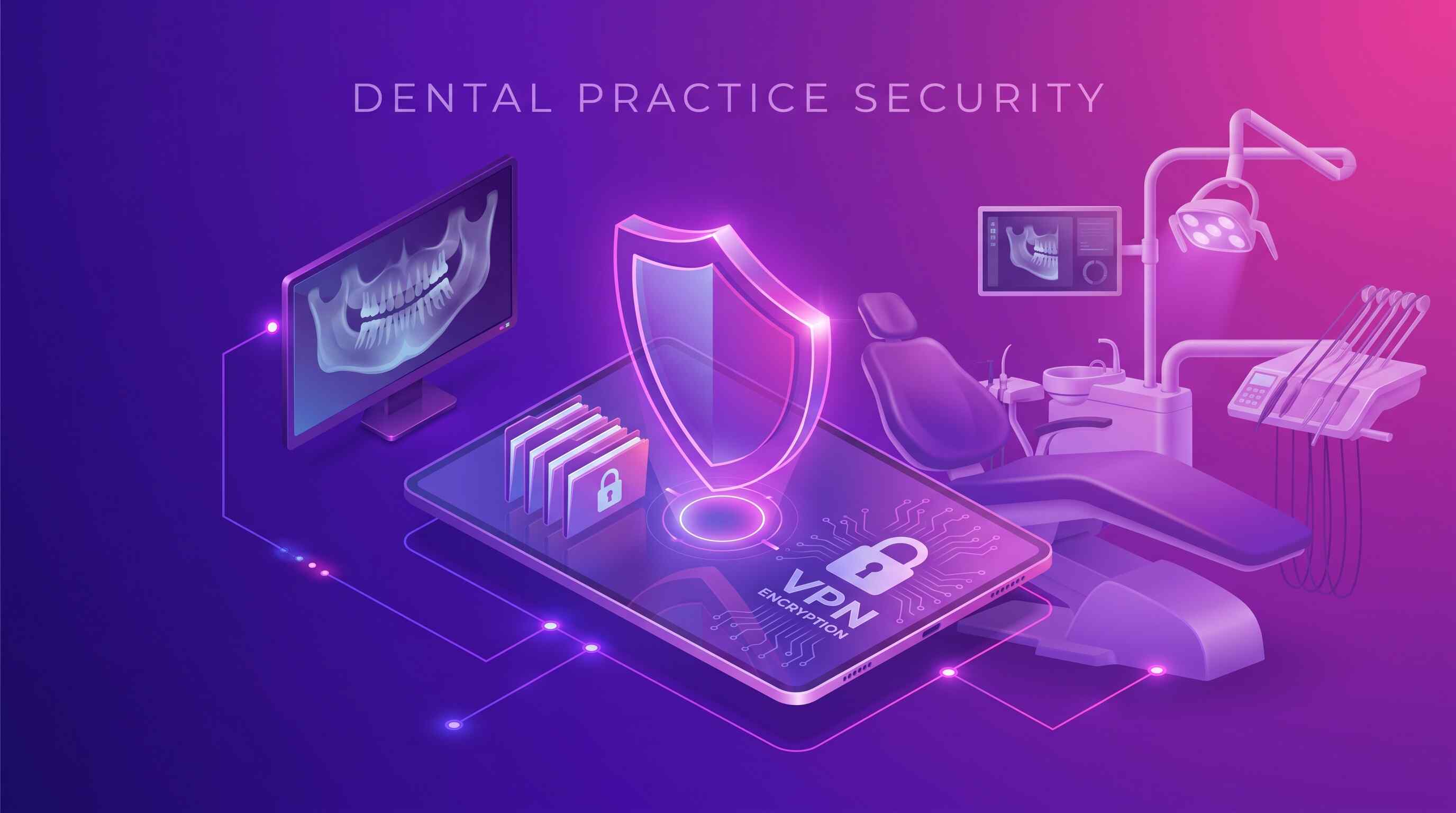
Dental practices handle some of the most sensitive personal data in healthcare: complete medical histories, X-rays, treatment records, financial information, and insurance details. Every day, dentists and hygienists access this data across multiple devices and locations—from office computers to mobile devices to home offices. Yet cybercriminals have discovered that dental practices offer a perfect target: valuable patient data combined with limited IT budgets (2-4%), outdated security infrastructure, and mission-critical business continuity pressure that makes ransom payments inevitable. Ransomware targeting dental practices has increased 290% since 2023, with average ransom demands reaching $45,000-$250,000. Learn how VPN, combined with a comprehensive security strategy, protects your patients, your practice, and your reputation.
Why Dentists Are Uniquely Vulnerable
Dentists occupy a unique position in the healthcare ecosystem that makes them particularly attractive to cybercriminals. Unlike large hospital systems with dedicated IT departments and substantial security budgets, most dental practices operate with small teams, limited technical expertise, and trust-based workflows that prioritize patient care over cybersecurity.
The Perfect Target Profile
Dental practices combine several factors that create an irresistible target for ransomware operators:
- Valuable data + small operations: Each patient record is worth $500-$2,000 on the dark web, yet practices average only 3-5 staff members managing security
- High payment incentive: Patients in pain don't wait; practices face immediate revenue collapse if systems go offline, forcing rapid ransom decisions
- Mobile workforce: Dentists work across multiple treatment rooms, hygienists move between patient chairs, and administrative staff work from anywhere—creating numerous unsecured WiFi connection points
- Outdated infrastructure: Many practices run legacy practice management software that hasn't been updated in years, with known security vulnerabilities
- Limited IT resources: Most practices have no dedicated IT staff or security personnel, relying instead on part-time consultants or hoping updates happen automatically
Ultra-Sensitive Dental Patient Data at Risk
Every patient record in a dental practice represents a complete profile that cybercriminals can exploit for identity theft, fraud, or double-extortion attacks.
The Data Goldmine
A single dental patient record typically contains:
- Complete medical history: Existing conditions, allergies, medications, previous surgeries—enabling targeted medical fraud
- X-rays and imaging: Digital images showing facial structure, dental anatomy, and identifying features used in biometric fraud
- Treatment records: Detailed notes about procedures, complications, and personal health information
- Financial data: Credit card numbers, bank account information, payment history, and insurance details
- Insurance information: Policy numbers, coverage details, and authorization codes for fraudulent claims
- Personal identifiers: Full names, dates of birth, social security numbers, driver's license numbers, addresses
- Contact information: Phone numbers, email addresses, emergency contacts enabling social engineering
Why Dental Data Is Premium on the Dark Web
Dental records combined with X-rays and facial images are worth 3-5x more than typical medical records on underground forums. Cybercriminals use this data for identity theft, medical fraud, deepfake generation, and insurance scams. Some dark web marketplaces specifically request "dental + X-ray + facial photo" packages, commanding $1,500-$2,500 per complete patient profile.
HIPAA Compliance & Regulatory Requirements
Dentists are required to comply with HIPAA (Health Insurance Portability and Accountability Act), which mandates specific safeguards for protected health information (PHI). A breach doesn't just damage your reputation—it exposes you to substantial financial and legal penalties.
HIPAA Requirements for Dental Practices
- Encryption: Patient data must be encrypted both in transit and at rest
- Access controls: Only authorized staff can access patient information
- Audit trails: All access to patient data must be logged and monitored
- Breach notification: You must notify affected patients within 60 days of discovery
- Business associate agreements: All vendors handling patient data must sign BAAs (Business Associate Agreements)
HIPAA Violation Penalties Are Severe
The HHS Office for Civil Rights imposes penalties ranging from $100 to $50,000 per violation. A breach affecting 500 patients could result in $50,000+ in violations plus liability lawsuits totaling hundreds of thousands of dollars. In 2025, a Denver dental practice was fined $385,000 for a ransomware breach affecting 42,000 patient records—plus settlement costs exceeded $500,000.
Major Digital Threats Targeting Dental Practices
Cybercriminals employ multiple attack vectors to penetrate dental practices and steal patient data.
Primary Attack Vectors
- Ransomware: Malicious software encrypts all practice data, making systems unusable until ransom is paid
- Phishing emails: Staff receive emails appearing to be from known contacts, requesting login credentials or containing malicious attachments
- Credential theft: Compromised passwords from data breaches enable unauthorized system access
- WiFi snooping: Unencrypted patient data transmitted over public or office WiFi is intercepted by nearby attackers
- Malware: Banking trojans, keyloggers, and spyware steal credentials and patient data from infected devices
- Insider threats: Disgruntled staff or contractors with legitimate access steal or sabotage data
- Practice management software exploits: Known vulnerabilities in outdated dental software are actively exploited
Ransomware Targeting Dental Practices
Ransomware has become the primary threat to dental practices, with cybercriminal gangs specifically targeting healthcare providers because of the guaranteed payment incentive.
The Ransomware Economics
Criminal organizations profit from dental practices because:
- Immediate payment pressure: When a practice's patient management system is encrypted, patients are waiting for appointments and treatments. Revenue stops immediately, forcing rapid ransom decisions
- High payment rate: 60-70% of targeted dental practices pay ransom, compared to 40-50% across other industries
- Manageable ransom amounts: Demands range from $45,000-$250,000, fitting within insurance coverage and emergency financing for dental practices
- Limited detection: Many practices don't discover the breach for days or weeks, giving attackers time to exfiltrate data and deploy double-extortion threats
Real-World Dental Ransomware Attack: Denver Smile Care Clinic (2025)
A medium-sized Denver dental practice was hit with ransomware affecting 3 office computers and their central patient database. Within hours, their practice management system was completely encrypted. Attackers demanded $120,000 within 48 hours, threatening to auction patient X-rays and personal medical information on the dark web. The practice paid $85,000, but still faced $220,000+ in incident response, recovery, HIPAA notifications, and lawsuit settlements. The clinic ultimately closed due to lost patient trust and reputation damage.
Mobile & Remote Work Security Risks
Modern dental practices operate across multiple locations and devices, each representing potential security vulnerabilities.
The Mobile Workplace Challenge
- Teledentistry sessions: Remote consultations conducted over public WiFi expose patient data during real-time communication
- Administrative work from home: Staff process insurance claims, schedule appointments, and manage billing from personal computers on home networks
- Mobile record access: Hygienists access patient records on tablets during treatment, transmitting data over office or guest WiFi
- Laptop vulnerability: Dentists carry practice management software on laptops between multiple practice locations, exposing data during transit
- Public WiFi dependence: Staff in break rooms, coffee shops for admin work, or between appointments connect to unencrypted networks
Double-Extortion Threats & Patient Privacy Breaches
Modern ransomware gangs employ "double-extortion" tactics: they encrypt your data AND threaten to publicly release it unless you pay additional extortion fees.
The Double-Extortion Model
After encrypting a dental practice's systems, cybercriminals:
- Demand payment to restore your data (typical ransom: $50,000-$150,000)
- Demand additional payment to prevent release of stolen patient data (additional: $25,000-$100,000)
- Threaten to contact patients directly about the breach, causing panic and reputation damage
- Threaten to sell patient X-rays and medical records to other cybercriminals or post them on public forums
- Threaten to share data with attorneys or journalists, creating reputational pressure independent of encryption
This creates an impossible situation: even if you restore from backups (avoiding the encryption ransom), you still face extortion threats about your stolen data.
How VPN Protects Your Patient Data
While a VPN alone cannot prevent ransomware, it's a critical component of a layered security strategy that significantly reduces your risk profile.
VPN Protection for Dental Practices
- Encrypted tunnels for sensitive data: All data transmitted between practice computers, mobile devices, and the internet passes through an encrypted tunnel that eavesdroppers cannot intercept
- WiFi security: Public WiFi attacks that normally compromise unencrypted practice management software are blocked by VPN encryption
- Teledentistry protection: Patient consultations conducted over VPN cannot be snooped by WiFi network attackers
- Mobile device security: Tablets and laptops used for remote work are protected even on untrusted networks
- ISP monitoring prevention: Your internet service provider cannot see what data you're transmitting across the network
- Man-in-the-middle attack prevention: Attackers positioned between your device and the internet cannot see or modify your data
- Credential protection: Passwords and login credentials transmitted over VPN cannot be intercepted by WiFi snoopers
Pro Tip: Always-On VPN with Auto-Reconnect for Dentists
Configure Free VPN with always-on mode and automatic reconnection on every device in your practice. This ensures that even if your VPN connection drops momentarily, it reconnects automatically before any unencrypted data is transmitted. This is especially critical for teledentistry sessions and remote staff accessing patient records.
7-Layer Security Strategy for Dental Practices
Comprehensive security requires multiple overlapping protections. VPN is one layer in a 7-layer strategy that dramatically reduces your breach risk.
Layer 1: VPN Encryption
Free VPN encrypts all data in transit across any network, preventing WiFi sniffing and man-in-the-middle attacks.
Layer 2: Endpoint Encryption
Enable full-disk encryption on all practice computers, laptops, and tablets. If a device is stolen, patient data remains protected even though the device is gone.
Layer 3: Access Controls & Authentication
Implement multi-factor authentication (MFA) on all accounts accessing patient data. Require strong, unique passwords for each staff member.
Layer 4: Regular Backups & Offline Storage
Maintain daily backups of all practice data, stored on an isolated, offline system. This allows recovery from ransomware without paying extortion.
Layer 5: Security Awareness Training
Train all staff on phishing recognition, password security, and safe handling of patient data. Most breaches start with a single staff member clicking a malicious link.
Layer 6: Software Updates & Patch Management
Keep all practice management software, operating systems, and security tools up to date. Many ransomware attacks exploit known vulnerabilities in outdated software.
Layer 7: Zero-Trust Architecture
Implement zero-trust principles: assume all network traffic is potentially hostile, verify every access request, and limit data access to what each staff member actually needs.
Key Takeaways
- Dental practices handle ultra-sensitive patient data worth $500-$2,000+ per patient on the dark web
- Ransomware targeting dental practices increased 290%+ since 2023 with average ransom demands of $45K-$250K
- HIPAA violations cost $100-$50,000+ per violation; double-extortion threatens patient confidentiality and triggers massive liability
- Patient X-rays, health histories, treatment records, and insurance data are prime extortion targets for cybercriminals
- Mobile/remote work patterns (teledentistry, home administrative work) expose patient data on unsecured WiFi networks
- Always-on VPN with auto-reconnect and kill switch protects practice data across all work locations and devices
- Combine VPN with endpoint encryption, secure password management, staff training, regular backups, and zero-trust architecture
- 24/7 internet privacy maintains patient confidentiality, builds trust, and demonstrates compliance with HIPAA requirements
Conclusion
Your dental practice holds the most sensitive information your patients will ever trust you with: their complete medical history, personal identifiers, financial information, and biometric data. Protecting this information isn't just a legal requirement under HIPAA—it's a moral responsibility to patients who depend on your discretion and security.
Cybercriminals have specifically targeted dental practices because of the perfect combination of valuable data, limited IT resources, and high payment incentives. By implementing Free VPN as part of a comprehensive 7-layer security strategy, you significantly reduce your vulnerability to ransomware, data theft, and double-extortion attacks.
Start today: enable always-on VPN on every practice device, implement multi-factor authentication, establish offline backups, and train your staff on security best practices. Your patients deserve nothing less than absolute protection of their private health information.