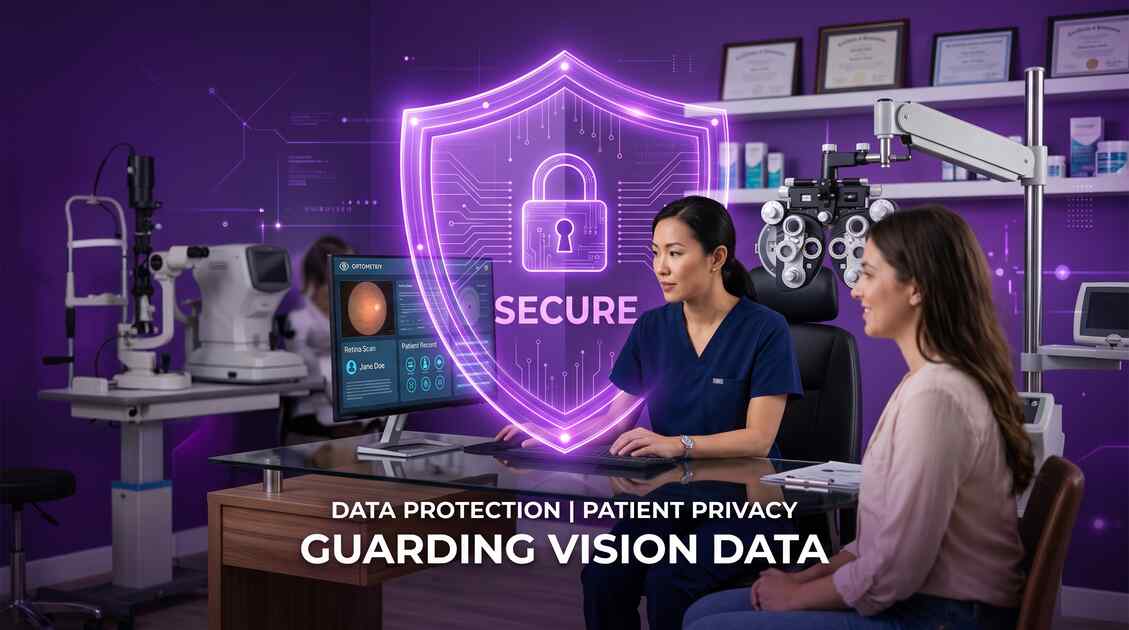
Optometrists and eye care professionals handle some of the most sensitive personal health data—prescription details, medical histories, family eye health conditions, insurance information, and contact data. Every patient record represents years of trust and intimate health information worth $500-$2,500+ on the dark web. Yet many independent optometrists and small practices operate with minimal cybersecurity protection, making them prime targets for ransomware attacks that have increased 275%+ since 2023.
Why Optometrists & Eye Care Professionals Are Vulnerable
Eye care practices face unique cybersecurity challenges that create a perfect storm for data breaches and ransomware attacks:
- Limited IT budgets: Most independent optometrists and small eye care practices operate with 2-5% of revenue dedicated to technology, leaving little for robust security infrastructure
- Legacy systems: Optical practice management software often runs on outdated systems with unpatched vulnerabilities
- High-value data: Patient vision data, prescriptions, insurance information, and contact details are incredibly valuable to criminals
- Mobile work patterns: Remote consultations, house calls for seniors, and telemedicine expansion means patient data travels across unencrypted networks
- Staff training gaps: Small practices rarely have dedicated security training programs, making employees targets for phishing attacks
- Business continuity pressure: Patients can't postpone eye care; delayed access to records creates maximum pressure to pay ransoms quickly
Ultra-Sensitive Patient Data at Risk
A single optometry patient record contains information that criminals find extremely valuable:
- Vision prescription details: Exact refractive errors, bifocal requirements, contact lens specifications—personal health data worth $200-$500 per record
- Medical histories: Diabetes, hypertension, glaucoma risk, age-related macular degeneration, amblyopia, astigmatism—conditions with significant insurance and employment implications
- Family eye health data: Hereditary conditions, genetic predispositions to blindness, family member contact information
- Insurance information: Insurance provider, policy numbers, copay amounts, coverage details
- Contact and personal data: Full names, phone numbers, email addresses, home addresses, birthdates, employer information
- Payment information: Credit card data, banking information, payment history
Market Value on Dark Web
A complete optometry patient record—including vision data, medical history, insurance, and contact information—sells for $500-$2,500+ on dark web marketplaces. A practice with 3,000 active patients represents $1.5M-$7.5M in potential stolen data value.
HIPAA, State Licensing & Compliance Requirements
Optometrists must comply with multiple regulatory frameworks protecting patient health information:
- HIPAA Compliance: Patient health records are protected health information (PHI). Violations carry penalties from $100-$50,000+ per violation, with breaches potentially costing $100,000-$1,000,000+ in penalties and settlements
- State Board Requirements: Most states require optometrists to implement reasonable safeguards for patient data. Failures can result in license suspension or revocation
- Insurance Carrier Requirements: Malpractice insurance policies increasingly mandate specific cybersecurity standards
- Business Associate Agreements (BAAs): Practices must ensure vendors who access patient data comply with HIPAA requirements
- State Privacy Laws: CCPA, GDPR (for international patients), and emerging state privacy laws create additional compliance obligations
Major Digital Threats to Eye Care Practices
Eye care practices face multiple cybersecurity threats that attackers actively exploit:
- Ransomware attacks: Malware that encrypts patient data and demands payment for decryption
- Phishing campaigns: Emails targeting staff with fake login pages or malicious attachments
- Weak password attacks: Brute force attacks against staff credentials
- Unpatched systems: Exploiting known vulnerabilities in outdated software
- Mobile device compromise: Remote consultations and telemedicine on unsecured personal devices
- WiFi interception: Attackers capturing patient data transmitted over unencrypted networks
Ransomware Targeting Optometry Practices
Ransomware gangs specifically target eye care practices because they know optometrists have:
- High-value patient data: Making ransom payments justify the attack effort
- Limited technical resources: Small practices struggle to detect and respond to attacks
- Business continuity pressure: Patients need urgent access to prescriptions and records
- Insurance coverage: Practices often carry cyber liability insurance willing to pay ransoms
Real-World Ransomware Attack
A Denver eye care practice was hit by ransomware demanding $180K. After negotiations, they paid $95K in ransom plus $120K in incident response and recovery costs, totaling $215K in direct costs—not including $180K+ in lost revenue from 6 weeks of partial operations and $95K in legal/settlement costs. The entire recovery took 4 months.
Telehealth & Remote Work Risks
The expansion of telemedicine and remote consultations has created new vulnerabilities for eye care practices:
- Unencrypted video consultations: Telehealth platforms may transmit patient data over unencrypted networks
- Personal device usage: Staff conducting consultations from personal computers without security controls
- Public WiFi connections: Optometrists working from coffee shops and home offices on unsecured networks
- Email transmissions: Sharing patient records via unencrypted email without proper authentication
- Cloud storage exposure: Patient data stored in cloud systems without adequate access controls
Double-Extortion Threats & Patient Privacy Breaches
Modern ransomware gangs use "double extortion"—a tactic specifically devastating for healthcare practices:
- Data encryption: First, attackers encrypt all patient data, making records inaccessible
- Data theft: Simultaneously, criminals steal copies of all patient files
- Dual ransom demand: Practices must pay to decrypt data AND prevent stolen data from being sold or published
- Patient notification pressure: HIPAA breach notification laws force practices to notify affected patients, exposing the breach publicly and creating liability
- Leveraging sensitive data: Attackers threaten to publish sensitive vision and medical data—creating maximum pressure for payment
VPN Protection Mechanisms for Eye Care Data
A VPN (Virtual Private Network) creates multiple layers of protection for patient data:
- Encryption of data in transit: All patient data traveling between devices and practice systems is encrypted using military-grade encryption (256-bit AES)
- IP address masking: The practice's real IP address is hidden, preventing attackers from identifying and targeting the practice's network
- Secure remote access: Staff can safely access patient systems from any location without exposing credentials or data
- WiFi interception prevention: Patient data cannot be intercepted or captured on public WiFi networks
- DNS leak protection: Prevents attackers from seeing which practice management systems or patient portals are being accessed
- Auto-reconnect protection: If the VPN connection drops, the auto-connect feature immediately re-encrypts the connection, preventing unencrypted data transmission
7-Layer Security Strategy for Optometry Practices
A VPN is foundational, but comprehensive protection requires multiple security layers:
Layer 1: VPN with Auto-Connect & Kill Switch
Always-on VPN encryption protects all patient data in transit. Free VPN's auto-connect feature ensures that even if staff forget to enable VPN, protection is automatic. The kill switch immediately blocks all internet access if the VPN connection drops, preventing unencrypted data leaks.
Layer 2: Multi-Factor Authentication (MFA)
Require all staff to use multi-factor authentication for accessing patient records. Even if passwords are compromised, attackers cannot access the practice management system without the second factor (authentication app, SMS, or hardware key).
Layer 3: Encrypted Email
Use encrypted email services for any patient communication containing sensitive health information. Unencrypted email is essentially sending postcards through the mail—anyone can read them.
Layer 4: Password Manager
A secure password manager like Bitwarden or 1Password ensures all staff use strong, unique passwords for practice systems. Password reuse and weak passwords are the #1 cause of successful hacking.
Layer 5: Regular Software Updates
Apply all security patches immediately for practice management software, operating systems, and all applications. Most ransomware exploits known vulnerabilities in outdated software.
Layer 6: Staff Security Training
Conduct quarterly phishing awareness training. Staff should learn to recognize fake emails, suspicious links, and social engineering attempts that target eye care practices.
Layer 7: Backup & Disaster Recovery
Maintain offline backups of all patient data—kept disconnected from the network so ransomware cannot encrypt backups. This ensures business continuity if an attack occurs.
Start with Free VPN Today
Download Free VPN for your entire practice team. Configure auto-connect on all devices so every staff member is protected immediately when connecting to the internet. No registration required, and it works on Windows, Mac, iOS, and Android.
Key Takeaways
- Optometrists handle ultra-sensitive patient data worth $500-$2,500+ per patient on the dark web, including vision prescriptions, medical histories, insurance, and contact information
- Ransomware targeting optometry practices increased 275%+ since 2023 with average ransom demands between $40K-$300K and total business losses exceeding $400K+
- HIPAA penalties range from $100-$50K+ per violation, making compliance critical for all eye care practices and independent optometrists
- Double-extortion threats weaponize sensitive vision data, medical conditions, and prescription details to maximize pressure on practices for ransom payment
- Telehealth expansion and mobile consultations expose patient data on unencrypted WiFi networks, requiring always-on VPN protection for all remote work
- A VPN combined with auto-connect, kill switch, and DNS leak protection creates a foundational security layer for all practice devices and remote consultations
- Multi-factor authentication, encrypted email, secure password managers, and regular staff training complete the 7-layer security defense against ransomware
Protecting Your Patients and Practice
Your patients trust you to protect their most sensitive health information. Implementing VPN protection combined with the 7-layer security strategy ensures that patient vision data, prescriptions, and medical histories remain secure—reducing ransomware risk, ensuring HIPAA compliance, and protecting your practice's reputation.
Start today by downloading Free VPN for all practice devices. Configure auto-connect so every staff member is automatically protected when connecting to the internet, whether in the office or during remote consultations. As threats evolve, your security must evolve too—and VPN protection is the foundation of modern eye care practice security.