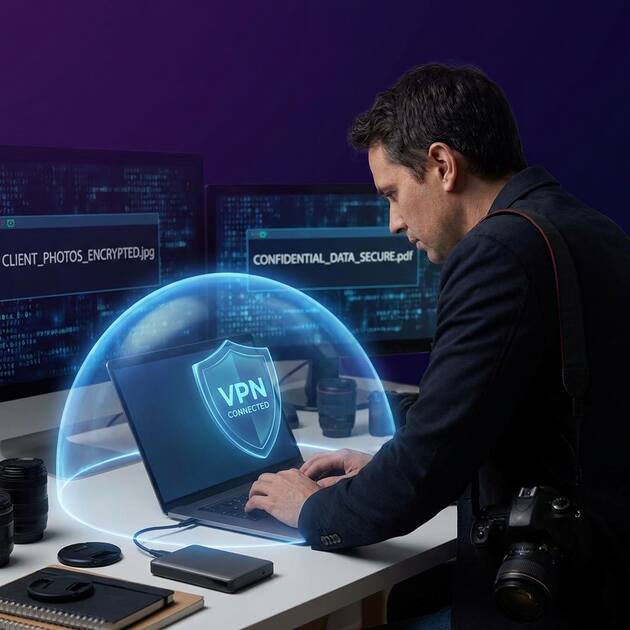
Professional photographers handle far more than just taking pictures. You manage sensitive client information, store valuable creative work, process payments, and operate a complex business—all heavily dependent on digital systems and data. Yet most photographers lack awareness of the digital security and privacy threats they face, leaving their livelihoods, client confidentiality, and creative work vulnerable to exploitation.
Why Photographers Face Unique Digital Threats
Photographers occupy a unique position that combines multiple risk factors that create significant digital security challenges:
- Trusted with sensitive information: Clients share personal details, event locations, family information, preferences, and sometimes confidential or intimate moments (weddings, maternity, family occasions)
- High-value creative assets: Photos represent significant intellectual property with commercial value, making them targets for theft and unauthorized use
- Distributed work environments: Photographers often work from home, edit on personal devices, use public WiFi, and access cloud storage from various locations, expanding attack surface
- Valuable metadata: Photos contain EXIF data revealing camera equipment, location coordinates, timestamps, and creative process details valuable to competitors
- Business visibility: Portfolio websites and social media expose business location, equipment, pricing, and client work, providing intelligence for competitors and criminals
- AI threat landscape: Creative work increasingly targeted by AI training scraping, unauthorized model training, and copyright violations with minimal compensation to creators
Client Data & Privacy Obligations
Whether you're a wedding photographer, headshot specialist, event photographer, or studio photographer, you handle personal client information requiring confidentiality protection:
- Personal identifiers: Names, contact information, addresses, phone numbers, email addresses
- Event details: Wedding dates, venue locations, guest lists, family relationships, relationship status
- Financial information: Payment details, contract terms, pricing, package selections
- Intimate moments: Many photographers capture sensitive personal moments (proposals, maternity, newborns, family occasions) clients want to remain private
- Professional data: Corporate event photographers handle confidential business events, board meetings, announcements, and proprietary information
Many photographers sign non-disclosure agreements (NDAs) protecting event details and client privacy. A data breach or privacy violation could expose this information, violating client trust and potentially triggering legal liability.
Professional Confidentiality Obligation
Even without explicit NDAs, photographers have an ethical and often legal obligation to protect client privacy. A single breach can permanently damage your reputation, result in lost clients, and create legal liability for privacy violations.
Image Theft & Copyright Infringement Risks
Your creative work is your intellectual property and business foundation, yet photographers face multiple image theft and copyright threats:
- Website scraping: Competitors and bad actors use bots to download your portfolio images for use in their own galleries without permission
- Social media theft: Instagram, TikTok, and Facebook images get stolen and reposted by other photographers, accounts, or commercial entities
- AI model training: Your photos are harvested without permission or compensation to train generative AI models that then compete with your creative work
- Unauthorized commercial use: Stolen images used in marketing, print materials, or commercial projects without license
- Portfolio fraud: Other photographers use your images as their own portfolio work, stealing your reputation and client trust
- Licensing violation: Clients or third parties share your licensed images beyond the scope of your agreement
A breach of your photography files could expose entire collections, portfolios, or unreleased work—potentially compromising your competitive advantage and enabling copyright theft at scale.
EXIF Metadata & Location Tracking Exposure
Every photo your camera or smartphone takes automatically includes EXIF metadata—technical data photographers often overlook:
- GPS coordinates: Exact location where photo was taken (event venue, client's home, studio location, travel locations)
- Timestamp: Date and time photo was captured
- Camera equipment: Camera model, lens, settings used, revealing your expensive equipment for theft targeting
- Mobile device info: If using smartphone, metadata reveals device model, OS version, unique identifiers
- Location history: Series of geotagged photos reveals movement patterns, work location, home location, travel patterns
Metadata leaks expose sensitive information about your business operations—when and where you're working, what equipment you use, your travel patterns, and client event details. Unencrypted uploads or unsecured file transfers make this metadata vulnerable to interception and analysis.
Critical: Metadata in Shared Images
Even after publishing images to portfolio websites, clients may strip EXIF data but often don't. Always remove EXIF metadata before sharing photos publicly, and ensure client files don't leak location, equipment, or timing information that reveals business operations or client details.
Portfolio & Business Location Security
Your photography portfolio and business presence online reveal valuable information about your operation:
- Business location exposure: Studio address, shooting locations, office location vulnerable to burglary, harassment, or physical threats
- Pricing and service details: Publicly visible pricing, packages, and service offerings provide competitive intelligence
- Client work examples: Published client portfolios reveal which clients you work with, event details, work style preferences
- Equipment visibility: Visible equipment in studio photos, behind-the-scenes content reveals expensive gear valuable to criminals
- Schedule exposure: Social media posts about events, locations, and timing can reveal when studio is empty or reveal client event details
Competitors monitor your portfolio for market intelligence. Criminals target high-value photography studios. Client privacy requires protecting event details and attendee information from public visibility.
Network & Device Security for Photography Work
Photography workflows involve multiple devices and network connections creating security vulnerabilities:
- Home WiFi security: Personal home network often poorly secured; editing workstations and backup servers exposed to weak password protection and unencrypted traffic
- Public WiFi usage: Photographers edit on laptops in coffee shops, edit suites, client locations, or travel—connecting to unencrypted public networks
- File transfers: Transferring large photo files via unencrypted email, unsecured cloud services, or unencrypted file sharing exposes data in transit
- Cloud storage risks: Dropbox, Google Drive, iCloud, and other cloud services accessed from unsecured networks or shared devices
- Device sharing: Household members, assistants, or family using same computers for personal browsing increases malware and compromise risk
- Unencrypted backups: External hard drives, NAS devices, and backup systems often unencrypted and vulnerable to theft
Payment Processing & Financial Data Protection
Photography businesses process client payments and maintain financial records requiring security protection:
- Payment processing: Credit card data from clients via payment processors, invoicing systems, or direct payments
- Financial records: Invoices, receipts, banking information, tax documents, revenue records
- Client financial data: Some clients provide payment details, deposit information, or financial arrangement details
- Business account access: Bank account access, payment processor accounts (Stripe, PayPal, Square), accounting software
Unencrypted transmission of financial data or access to payment systems over public WiFi exposes both your revenue and client payment information.
How VPN Protects Photographers
A Virtual Private Network (VPN) provides critical protection for photographers across multiple threat vectors:
IP Masking & Location Privacy
VPN masks your public IP address, hiding your physical location from websites, file uploads, and surveillance systems. When uploading photos, client files, or accessing business accounts, your real IP address—which could pinpoint your studio location—remains hidden.
Encrypted Data Transmission
VPN encrypts all data passing through your connection, protecting file transfers, cloud uploads, and business communications from interception. When uploading large photo files to cloud storage or sending client deliverables, VPN encryption prevents eavesdropping on file contents.
Public WiFi Protection
When editing on laptops in coffee shops, travel locations, or client sites, VPN protects all traffic from interception by other network users, the WiFi operator, or ISP monitoring.
DNS Privacy
VPN protects domain lookups, preventing ISPs or network operators from seeing which websites and services you access (portfolio sites, cloud storage, payment processors, photography forums).
ISP Monitoring Prevention
ISPs can see your browsing without VPN. VPN prevents ISP visibility into your photography work, client management activities, and business operations.
VPN First Approach for Photography
Establish the practice of connecting to Free VPN BEFORE opening any photography applications, accessing client files, uploading to cloud storage, or processing payments. Make VPN automatic by enabling auto-connect on all devices used for photography work.
Building a Comprehensive Protection Strategy
While VPN is essential, comprehensive protection for photographers requires a multi-layer approach:
Layer 1: Network Encryption with VPN
VPN is your first line of defense, encrypting all traffic and protecting data in transit. Always use Free VPN before accessing photography applications, client data, cloud services, or payment systems.
Layer 2: Device Security
- Keep operating systems, photo editing software, and all applications updated with latest security patches
- Use strong, unique passwords for all accounts and enable two-factor authentication (2FA)
- Run antivirus and antimalware software on all editing workstations
- Use full-disk encryption on laptops and devices handling client data
Layer 3: Data Handling & Storage
- Encrypt cloud backups at rest and in transit
- Use encrypted external drives for offline backups
- Implement access controls limiting who can access client files
- Remove EXIF metadata from published images before distribution
- Use dedicated external drives for specific client projects (isolate client data)
Layer 4: Secure File Transfers & Sharing
- Use end-to-end encrypted file sharing services for client deliverables (not just email or Dropbox)
- Password-protect client file downloads or require authentication
- Set expiration dates on shared file access
- Use client portals with access controls instead of direct file sharing
Layer 5: Access Controls & Authentication
- Enable 2FA on all business accounts (email, cloud storage, payment processors)
- Use separate user accounts for different client projects on shared workstations
- Implement password managers for strong password generation and storage
- Use separate email addresses for different business functions
Layer 6: Operational Security & Client Privacy
- Implement clear client confidentiality policies and share with clients
- Request NDAs when handling sensitive client information
- Develop protocol for client data requests or subpoenas
- Maintain secure deletion procedures for archived client data
- Train any assistants or household members on data security practices
This comprehensive, multi-layer approach ensures that VPN is part of a complete security strategy protecting your creative work, client confidentiality, and business operations.
Key Takeaways
- Photographers handle sensitive client information (contact details, event locations, personal preferences) requiring confidentiality and privacy protection
- Image files contain exploitable EXIF metadata revealing camera equipment, location coordinates, GPS data, and timestamps that expose creative process
- AI training data scraping increasingly targets creative work, with unauthorized use of photos for model training without consent or compensation
- Portfolio websites and business locations are high-value targets for competitors seeking market intelligence and pricing information
- Unencrypted file transfers, unprotected cloud backups, and public WiFi usage expose work-in-progress images and client data to interception
- VPN masks IP address during uploads, protects data transmission during file transfers, secures backup procedures, and prevents ISP monitoring
- Secure file transfers require encryption beyond VPN, including end-to-end encrypted services, strong passwords, and access controls on deliverables
- Professional liability increases with client confidentiality obligations—many wedding/event photographers sign NDAs protecting event details and attendee privacy
- Multi-layer protection strategy combines VPN, device security, secure cloud access, encrypted backups, secure file transfers, and operational security practices
Your Photography Business Deserves Complete Protection
Professional photographers operate at the intersection of creative work, client confidentiality, and business operations. Your images are your intellectual property. Your clients' information deserves privacy protection. Your business operations require security from competitor surveillance and theft.
VPN is an essential first step in protecting your photography business, but complete protection requires a comprehensive multi-layer strategy combining network encryption, device security, secure file handling, access controls, and professional operational security practices.
Free VPN provides the network encryption foundation you need to protect data transmission, prevent ISP monitoring, secure public WiFi connections, and mask your location during uploads and cloud backups. Combined with the additional security layers outlined in this guide—encryption at rest, secure file transfers, access controls, and client confidentiality practices—you build a comprehensive defense protecting your creative work, client privacy, and business from digital threats.
Protecting your photography business isn't optional. It's professional responsibility. Download Free VPN today and establish the security practices that protect your livelihood.