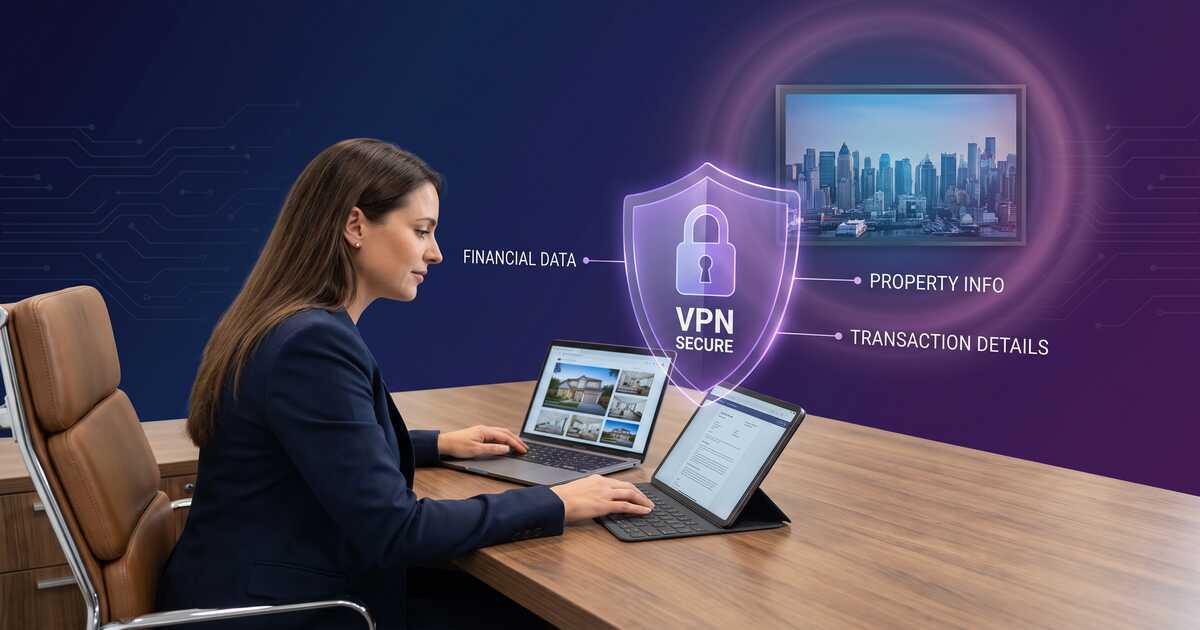
Real estate professionals handle some of the most sensitive financial and personal data in any industry—mortgage pre-approvals showing bank balances, credit scores, Social Security numbers, home addresses, investment properties, closing documents, and transaction details worth millions. Yet real estate firms operate with limited IT resources, remote work patterns expose data on public WiFi, and ransomware attacks targeting real estate have increased 225% since 2023. In 2026, protecting client data isn't just a security best practice—it's a legal and ethical imperative that determines whether your clients trust you with their most valuable transactions.
Why Real Estate Agents Face Unique Security Risks
Real estate professionals operate in a unique threat landscape. Your clients' financial information, home addresses, and deal terms are worth money to criminals. At the same time, your work model—property showings, open houses, client meetings, remote inspections, virtual closings—forces you to work from unsecured locations: coffee shops, client homes, airports, parking lots, and home offices on residential WiFi.
The Perfect Storm
- High-value data: Real estate transactions routinely involve hundreds of thousands of dollars. Client financial details unlock identity theft, fraud, and ransom leverage.
- Mobile workforce: You're rarely in a secure office. Remote work from public WiFi is standard practice.
- Limited IT budgets: Most real estate firms (especially independent agents and small brokerages) allocate only 2–5% of revenue to IT security versus 15%+ for comparable businesses.
- Trust-based culture: Real estate operates on relationships and trust. Many agents underestimate cybersecurity as a competitive concern.
- Ransomware increase: Real estate has been among the fastest-growing ransomware targets. A single attack can cost $50K–$500K in ransom plus recovery, legal, and client notification expenses.
- MLS vulnerabilities: Multiple Listing Services (MLS) and brokerage platforms are common attack vectors that can compromise agent credentials across entire organizations.
Real Estate Ransomware Case Study
A mid-size real estate brokerage in Texas was attacked in 2024: ransomware encrypted MLS access, transaction files, and client records. Attackers demanded $180K. Total costs included ransom ($180K), recovery/remediation ($450K), legal/compliance ($280K), client notification ($95K), and reputation damage (loss of $400K in future commissions). Total impact: $1.4M. The firm took 3 weeks to recover systems and permanently lost 2 major clients.
Sensitive Data at Risk in Real Estate
Every transaction you handle contains data criminals actively seek. Here's what's at risk:
- Mortgage pre-approval letters: Show income, employment, bank account balances, credit score, and financial history. Worth $100–$500 per document on the dark web.
- Financial statements: Tax returns, bank statements, investment account statements. Worth $250–$1K each.
- Government ID copies: Driver's licenses, passports, SSNs. Worth $100–$500 per identity.
- Home address & property data: Exact location, property tax records, purchase price history. Used for targeted crime (burglary, home invasion). Worth $50–$200.
- Title & deed information: Ownership records, lien details. Worth $500–$2K for title fraud schemes.
- Inspection & appraisal reports: Property vulnerabilities, hidden issues. Worth $500–$5K for repair scams.
- Closing documents: Transaction details, wire instructions, escrow amounts. Worth $1K–$10K for fraud/interception.
- Client contact lists: Names, phone numbers, email addresses. Worth $250–$1K for phishing and social engineering.
- Bank account information: Wiring instructions, account numbers. Used for wire fraud and theft. Worth thousands.
Total Exposure Per Client
A single real estate transaction typically exposes 8–12 categories of sensitive data. If one brokerage works with 100 active clients, that's 800–1,200 data points worth $50K–$500K on criminal markets.
Compliance & Regulatory Obligations
Real estate professionals operate under strict regulatory frameworks requiring data protection:
- State real estate licensing laws: Require agents and brokers to maintain client confidentiality and protect transaction information. Violations can result in license suspension or revocation.
- Fair Housing Act (FHA): Requires protection of client information; violations carry federal penalties.
- Real Estate Settlement Procedures Act (RESPA): Mandates confidentiality of settlement documents and closing information.
- State privacy laws: California (CCPA), Colorado (CPA), and others require businesses to protect personal information and notify clients of breaches within specific timeframes.
- MLS privacy standards: Most MLS systems require agents to comply with data protection standards or face account suspension.
- Brokerage policies: Brokers impose contractual data protection requirements on agents; breaches can result in termination or liability claims.
- Client contracts: Many buyer/seller agreements include clauses requiring agents to protect confidential transaction information.
Non-compliance with these requirements can result in fines, license loss, civil lawsuits, and reputational damage that destroys client relationships and career opportunities.
Digital Threats Targeting Real Estate
Real estate professionals face a growing array of targeted cyber attacks:
Email Phishing & Spear-Phishing
Attackers send emails impersonating clients, lenders, title companies, or brokers, requesting wire transfers or login credentials. Success rate: 20%+ for real estate-targeted campaigns. Average loss per successful phishing attack: $10K–$100K in fraudulent wire transfers.
Public WiFi Interception (MITM Attacks)
When agents access MLS, client databases, or email from coffee shops, airports, or client offices on unencrypted WiFi, attackers can intercept credentials, emails, and transaction details. Cost to intercept and sell credentials: minimal; cost to you: client data breach.
Ransomware via Supply Chain
MLS platforms, transaction management software (Dotloop, Zipforms, Follow Up Boss), electronic signature services (DocuSign), and payment processors are frequent targets. A breach in one platform can compromise thousands of agents' data simultaneously.
Credential Theft & Account Takeover
Stolen MLS, email, or transaction platform credentials allow attackers to impersonate agents, access client data, or inject themselves into transaction communications to redirect wire transfers.
Mobile Device Compromise
Smartphones and tablets used for showings, client meetings, and remote document signing are frequent targets. Malware can exfiltrate email credentials, banking information, and client data.
Did You Know?
68% of real estate agents access client data from public WiFi at least once per week. Without a VPN, each session exposes credentials and sensitive documents to potential interception. Attackers use automated tools to harvest credentials from unencrypted coffee shop networks within minutes.
Why Real Estate is a Ransomware Target
Real estate firms have become the #1 target for ransomware in 2024–2026. Here's why criminals love targeting real estate:
Double-Extortion Business Model
Attackers encrypt your systems AND steal client data, then threaten to publish it if you don't pay. Real estate data is especially effective for extortion because it's highly sensitive: clients will pressure you to pay to keep their financial information private.
Time-Critical Pressure
Real estate transactions have immovable deadlines—closing dates, inspection periods, financing contingencies. An attack 48 hours before closing forces agents to either pay the ransom or risk deal collapse and client lawsuits.
High Ransom Potential
Average real estate ransomware ransom demand: $50K–$500K. Larger brokerages and firms managing multiple concurrent transactions pay even more because the cost of transaction delays exceeds the ransom.
Regulatory Pressure
Real estate firms must comply with data breach notification laws, triggering legal costs, fines, and notification expenses. Paying the ransom avoids public breach disclosure.
Network Vulnerabilities
MLS platforms, transaction management systems, and email are common entry points. Attackers exploit weak passwords, unpatched software, and VPN-less remote work to establish persistence and spread laterally through networks.
Remote & Mobile Work Risks
Real estate work is inherently mobile. You conduct property showings, open houses, client meetings, and inspections outside controlled office environments. This creates unprotected moments:
- Public WiFi showings: Accessing MLS, client details, or transaction documents from WiFi at client properties or open houses.
- Coffee shop client meetings: Email, contracts, and financial documents on unencrypted shop WiFi.
- Airport/hotel WiFi during travel: Accessing client records while traveling to meetings or managing remote closings.
- Home office residential WiFi: Less secure than corporate networks; vulnerable to neighbor password-cracking and device compromise.
- Mobile device access: Smartphones and tablets used for document signing, photo uploads, and client communication often have weak authentication and outdated OS.
- Metadata exposure: Even "private" communications leak IP addresses, location data, and device information that can be traced and exploited.
Without a VPN, every mobile session is a potential data breach waiting to happen.
How VPN Protects Your Business
A VPN (Virtual Private Network) encrypts all data transmitted from your device, protecting against the threats real estate professionals face daily:
Encryption in Transit
VPN encrypts all traffic (AES-256 or stronger) so WiFi eavesdropping becomes useless. Attackers intercept encrypted data instead of readable credentials and documents.
Location Masking
Your actual IP address is hidden, replaced with the VPN server's IP. Clients and attackers can't determine your location from network traffic, reducing targeting and geolocation attacks.
DNS Privacy
VPN protects DNS queries, preventing ISPs and attackers from seeing which websites you visit (including MLS platforms, banking sites, transaction software).
MITM Attack Prevention
Encrypted tunnel prevents man-in-the-middle attacks on public WiFi. Even if an attacker controls the WiFi, they can't intercept your data.
Authentication & MFA Compatibility
VPN works alongside multi-factor authentication (MFA) on MLS, email, and transaction platforms. Even if credentials are stolen, attackers can't access accounts without MFA tokens.
Incident Response Forensics
VPN logs (when retained) help identify when and how data was exposed, essential for breach investigation and regulatory response.
Pro Tip: Auto-Reconnect is Non-Negotiable
Use a VPN with automatic reconnection (kill switch). If your VPN connection drops, the kill switch blocks all internet traffic until the VPN reconnects. This prevents accidental unencrypted data transmission if your WiFi disconnects during a showing or meeting.
7-Layer Security Strategy for Real Estate
VPN is foundational, but real estate data requires layered defense. Implement this 7-layer strategy:
Layer 1: Always-On VPN with Auto-Reconnection
Enable VPN on startup and maintain constant encryption during remote work. Auto-reconnection (kill switch) ensures unencrypted data never leaks.
Layer 2: Full Device Encryption
Encrypt your laptop and smartphone hard drives (FileVault on Mac, BitLocker on Windows, LUKS on Linux, built-in encryption on iOS/Android). If a device is stolen or compromised, encrypted data remains inaccessible.
Layer 3: Multi-Factor Authentication (MFA)
Enable MFA on all critical accounts: MLS login, email, transaction platforms, banking, brokerage systems. Even stolen passwords won't grant access without MFA tokens.
Layer 4: Encrypted Communications & Email
Use end-to-end encrypted email for sensitive documents (ProtonMail, Tutanota) and secure document portals instead of email attachments. Avoid sending financial details, SSNs, or identification via unencrypted email.
Layer 5: Access Controls & Least Privilege
Grant each team member only the access they need. Separate client data by transaction; restrict who can access payroll or banking information. Audit access logs monthly.
Layer 6: Monitoring, Logging & Intrusion Detection
Deploy endpoint detection and response (EDR) software on all devices. Monitor for unusual login attempts, credential access, and lateral movement. Real-time alerts enable rapid response to breaches.
Layer 7: Backups & Business Continuity
Maintain offline backups of critical data (MLS databases, transaction files, client records). Test recovery procedures quarterly. If ransomware strikes, you can restore data without paying ransom.
Protecting Client Data & Transactions
Your clients entrust you with their most valuable assets. Here's how to protect that data:
Secure Remote Access
Always use VPN when accessing MLS, transaction platforms, email, or client records from anywhere but your secure office. This includes property showings, client meetings, and home office work.
Encrypted Document Storage
Store client documents in encrypted cloud storage (OneDrive with BitLocker, Google Drive with client-side encryption, or Tresorit). Avoid USB drives or unencrypted local storage.
Secure Collaboration Tools
Use secure platforms for client communication: encrypted email, password-protected portals, or secure document signing (DocuSign with VPN) instead of text, unencrypted email, or public file-sharing.
Incident Response Plan
Document who to contact if a breach occurs: your broker's security team, your cyber insurance provider, legal counsel, and regulatory authorities. Practice the plan quarterly.
Key Takeaways
- Real estate agents handle some of the most sensitive financial and personal data in any industry: mortgage pre-approvals, bank account info, home addresses, identification documents, and credit details worth $100–$50K+ per client
- Real estate firms are increasingly targeted by ransomware (225%+ increase since 2023) with average ransom demands of $50K–$500K, plus recovery costs, legal fees, and client notification expenses
- Mobile work patterns (property showings, open houses, client meetings at coffee shops) create unprotected moments where data can be intercepted via public WiFi or network interception
- Compliance obligations include state licensing laws, FHA regulations, RESPA requirements, state data privacy laws (CCPA/GDPR), and MLS privacy standards that require data protection
- Double-extortion attacks threaten real estate firms: attackers encrypt systems AND threaten to release client financial data and property information, creating intense pressure to pay ransoms
- Always-on VPN with auto-reconnection is the foundational layer that protects against WiFi interception, MITM attacks, and unencrypted data exposure during remote work
- A 7-layer security strategy (VPN + device encryption + MFA + encrypted communications + access controls + monitoring + backups) reduces ransomware impact and ensures business continuity
- VPN protects client data in transit while agents access client records from remote locations, secure showings, and negotiate deals outside the office
Conclusion: Real Estate Security is Client Trust
In 2026, real estate professionals face a choice: invest in data protection now, or risk losing client trust, facing regulatory penalties, and paying massive ransomware ransoms later. Your clients entrust you with their largest financial transactions and most sensitive personal information. A single data breach doesn't just expose their data—it destroys the relationship that built your career.
VPN is the first and most essential layer of that protection. When you use a VPN with auto-reconnection, your client data remains encrypted in transit regardless of whether you're in your office, a client's home, a coffee shop, or an airport. Device encryption, MFA, and backup systems create multiple barriers against ransomware and data theft.
Real estate is built on trust. Protecting client data isn't a technical problem—it's a professional obligation. Download Free VPN today and commit to the 7-layer security strategy. Your clients (and your future self) will thank you when the next ransomware attack strikes and you're ready to respond without exposing anyone's data.