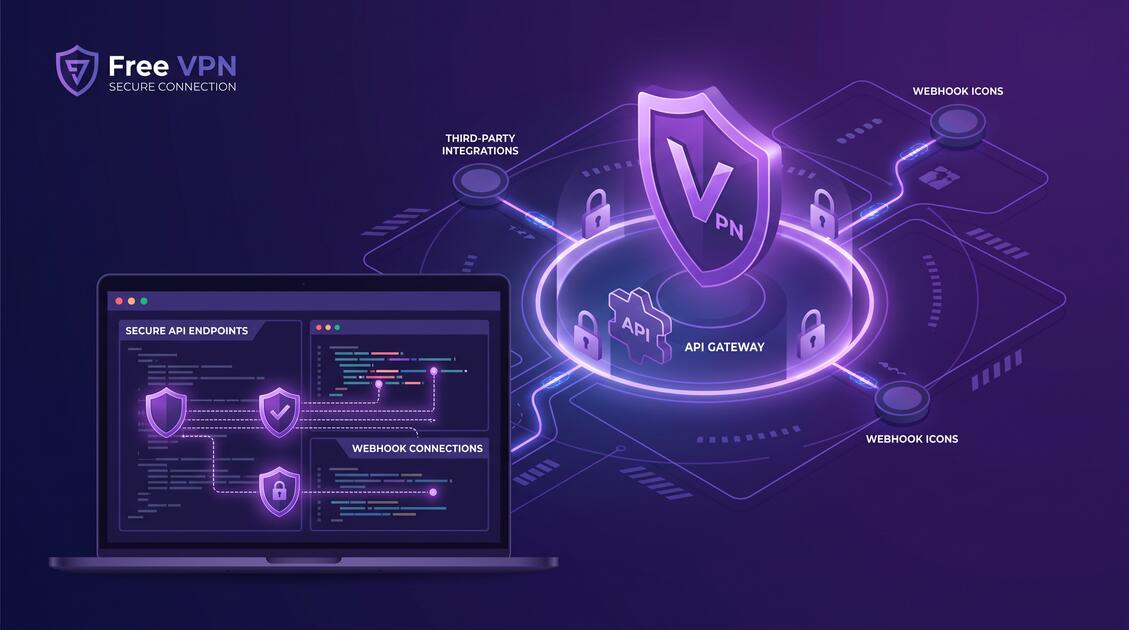
Your API infrastructure is the backbone of your digital operations—but most developers don't realize how vulnerable their API keys, webhooks, and integrations really are. Every unencrypted API call exposes your backend to potential compromise, credential theft, and unauthorized access. This comprehensive guide explains the hidden risks in your API ecosystem and how VPN protects your entire infrastructure from exposure to exploitation.
Understanding API Security Threats
APIs (Application Programming Interfaces) are the connectors that power modern development. They link your servers to third-party services, mobile apps, frontend interfaces, and internal microservices. But each connection represents a potential vulnerability.
The problem: Most developers transmit API calls over standard HTTPS, which provides encryption in transit. However, this doesn't protect against attackers operating at the network level or compromised servers at either endpoint. Additionally, many development, testing, and staging environments use less secure protocols entirely.
Common API security threats include:
- Man-in-the-middle (MITM) attacks: Intercepting unencrypted or weakly encrypted API calls to steal credentials, authentication tokens, or sensitive data
- API endpoint enumeration: Discovering your API structure and endpoints by monitoring network traffic
- Credential harvesting: Extracting API keys and OAuth tokens from network packets
- Webhook spoofing: Injecting fake webhook events into your infrastructure
- Integration hijacking: Replacing legitimate third-party integrations with malicious versions to steal data
- DDoS amplification: Using APIs as vectors for distributed denial-of-service attacks
Did You Know?
According to recent API security reports, over 95% of organizations have experienced at least one API-related security incident in the past 12 months. The most common cause? Inadequate encryption and network-level exposure of API credentials.
How API Keys Get Exposed
API keys are essentially passwords that grant direct access to your backend services. Unlike user passwords, API keys often have broader permissions and longer lifespans—making them valuable targets for attackers.
Common API Key Exposure Vectors
- Unencrypted transmission: Sending API keys over non-HTTPS connections, unencrypted email, or chat messages
- Log files: API keys accidentally logged in application logs, error messages, or monitoring tools
- Git repositories: Keys committed to version control (especially public repositories)
- Network sniffing: Attackers intercepting API calls on shared WiFi or compromised networks without VPN protection
- Code decompilation: Mobile and desktop apps with hardcoded API keys extracted through reverse engineering
- Third-party breaches: Compromised integrations or service providers leaking your API credentials
- Careless developers: API keys shared in Slack, GitHub issues, or support tickets
Critical Warning
Many developers rotate API keys reactively (after a breach) rather than proactively. A single exposed API key can grant attackers full access to your backend infrastructure, databases, customer data, and payment systems. Always assume compromised keys and use defense-in-depth security.
Webhook Vulnerabilities & Man-in-the-Middle Attacks
Webhooks are event-driven mechanisms where external services send data to your servers (e.g., Stripe payment notifications, GitHub push events, Slack integrations). These are particularly vulnerable to attack.
Webhook Security Risks
When webhooks are transmitted without VPN protection, attackers can:
- Intercept webhook payloads: Capture sensitive data like payment information, customer records, or authentication tokens
- Inject malicious webhooks: Send fake webhook events to trigger unauthorized actions (e.g., charge refunds, access restricted data)
- Replay attacks: Resend captured webhook events to repeat transactions or corrupt data
- Modify webhook data: Alter webhook content in transit (e.g., change payment amounts, user IDs, or status updates)
- Extract endpoint URLs: Discover your internal webhook endpoints to map out your architecture
Pro Tip
Always verify webhook authenticity using cryptographic signatures (HMAC-SHA256). But verification alone isn't enough—combine it with VPN encryption to prevent man-in-the-middle attacks at the transport layer. Defense in depth requires protection at both application and network layers.
Third-Party Integration Risks
Modern applications rely on dozens of third-party APIs (payment processors, email services, analytics platforms, CRM systems, etc.). Each integration represents a potential security vulnerability.
Integration Security Challenges
- Credential management: Storing API keys for multiple third-party services introduces multiple points of failure
- Shared secrets: Team members accessing integration credentials increases exposure risk
- Legacy integrations: Older services with weak or outdated authentication mechanisms
- Third-party compromise: Your credentials stored on compromised third-party servers
- Supply chain attacks: Malicious actors targeting integrations to breach multiple customers
- Unencrypted data flow: Integration services sending unencrypted data across public networks
How VPN Protects Your API Infrastructure
Free VPN provides multiple layers of protection for your API ecosystem by encrypting all network traffic at the transport layer, regardless of application-level encryption.
1. End-to-End API Encryption
Every API call—whether to your own servers, third-party services, or webhooks—is encrypted through the VPN tunnel. This prevents network-level attackers from seeing the content of your API traffic, even if they compromise the network path.
2. Developer Environment Protection
Development, testing, and staging environments often use less secure protocols. Free VPN secures all API calls from development machines, ensuring that even when developers work on public WiFi or through compromised networks, their API keys and requests remain protected.
3. Microservices Communication Security
For containerized deployments and microservices architectures, Free VPN protects inter-service communication. API calls between your microservices, databases, and message queues are encrypted regardless of whether they traverse public internet or private networks.
4. Third-Party Integration Protection
When you connect through Free VPN, all outbound API calls to third-party services benefit from encryption and anonymity. This prevents third-party services from profiling your usage patterns or third parties from intercepting your credentials.
5. Mobile & Remote Access Protection
Mobile apps and remote developers connecting to your APIs are protected by Free VPN's automatic encryption, ensuring that API calls made from anywhere—home networks, coffee shops, airports—are secure.
Best Practices for Securing APIs with VPN
1. Use VPN for All API Environments
Don't limit VPN to production. Protect development, testing, and staging APIs equally. Attackers often target less-protected environments knowing they'll have easier access to credentials and data.
2. Implement API Gateway with VPN
Deploy an API gateway (Kong, AWS API Gateway, Nginx) and access it through VPN. This provides centralized authentication, rate limiting, and request validation—all encrypted through your VPN tunnel.
3. Enable Mutual TLS (mTLS) + VPN
For sensitive APIs, require mutual TLS authentication (client certificates) in addition to VPN encryption. This creates a two-factor encryption system: VPN protects the transport layer, while mTLS authenticates both endpoints.
4. Rotate API Keys Regularly
Even with VPN protection, rotate API keys every 90 days. Implement automated key rotation for service-to-service authentication. Use short-lived tokens (OAuth 2.0 with 1-hour expiration) instead of long-lived API keys.
5. Monitor API Access Through VPN
Log all API access, including which VPN server was used for the connection. This helps detect unusual access patterns or compromised credentials. If an API key is exposed, you can identify which connections used that key.
6. Separate API Keys by Environment
Use different API keys for development, testing, and production. If a development key is compromised, your production systems remain unaffected. All keys should still be transmitted through VPN.
7. Webhook IP Allowlisting + VPN
For incoming webhooks, allowlist the IP addresses of webhook sources. But combine this with VPN for outgoing webhooks to third-party services. This defense-in-depth approach prevents both incoming and outgoing webhook attacks.
API Security Checklist
Use this checklist to assess and improve your API security posture:
- ✓ Network encryption: All API calls encrypted (HTTPS + VPN)
- ✓ Authentication: Strong API key management with regular rotation
- ✓ Authorization: Principle of least privilege (APIs only access required resources)
- ✓ Rate limiting: API throttling to prevent brute force and DoS attacks
- ✓ Webhook verification: HMAC signatures validated for all incoming webhooks
- ✓ Logging: All API access logged for audit and intrusion detection
- ✓ Monitoring: Real-time alerts for unusual API access patterns
- ✓ Key rotation: API keys rotated every 90 days minimum
- ✓ Environment separation: Different credentials for dev, test, production
- ✓ Vendor security: Third-party integrations vetted for security practices
- ✓ VPN protection: All developers and services connect through VPN
- ✓ Incident response: Documented procedures for API key compromise
Key Takeaways
- API keys exposed through unencrypted connections can give attackers access to your entire backend infrastructure
- Webhooks transmitted over standard HTTP are vulnerable to man-in-the-middle attacks that intercept and modify data
- VPN protects API traffic by encrypting all data transmitted between your servers, clients, and third-party services
- API gateway security combined with VPN creates a layered defense against unauthorized access and data theft
- Third-party integrations require VPN protection to prevent credential harvesting and integration spoofing attacks
- Free VPN's automatic encryption secures API calls from development, testing, and production environments
Protecting Your API Infrastructure
Your API infrastructure is a high-value target for attackers because it grants direct access to your backend systems, databases, and customer data. A single compromised API key or intercepted webhook can lead to complete infrastructure compromise.
Free VPN provides essential protection for your API ecosystem by encrypting all traffic at the transport layer, protecting both outbound API calls to third-party services and inbound webhook traffic. Combined with strong API key management, regular rotation, cryptographic verification, and monitoring, VPN creates a comprehensive defense against API-based attacks.
Don't treat API security as an afterthought. Implement VPN protection for all developers, services, and integrations. Your infrastructure's security depends on it.