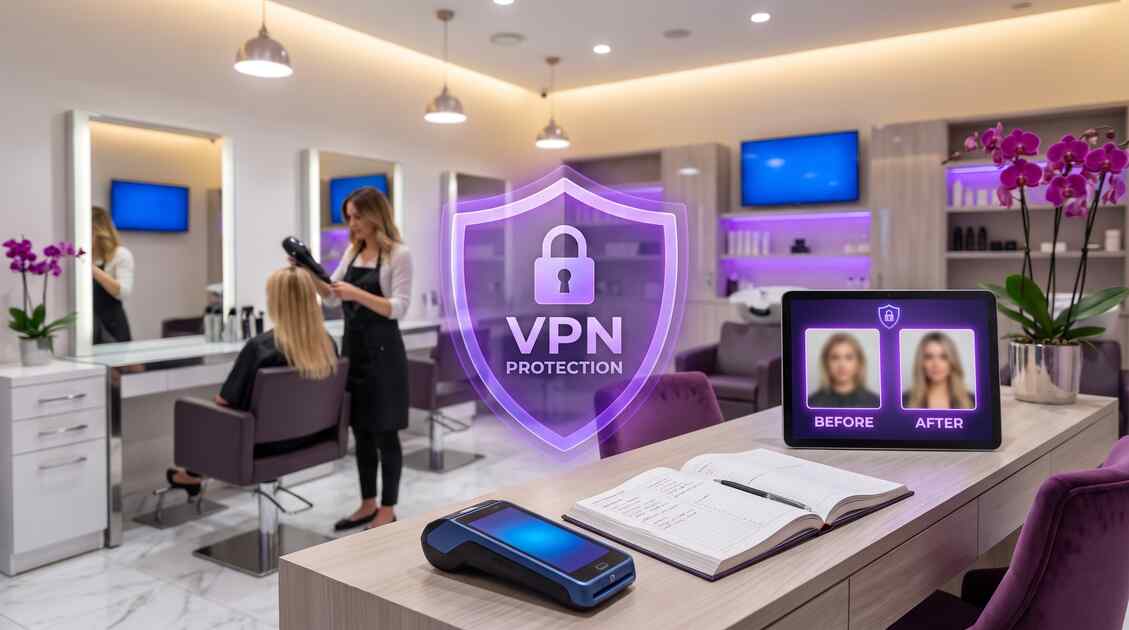
Salon and beauty professionals—hairstylists, estheticians, makeup artists, spa owners, and nail technicians—handle some of the most intimate information about their clients. From appearance preferences and personal photos to appointment histories and payment information, beauty professionals are custodians of data that, if compromised, can damage client privacy and business reputation. Yet most beauty professionals operate with minimal cybersecurity infrastructure, making them prime targets for data theft, ransomware attacks, and privacy breaches. This guide shows you how to protect your clients' data and your business with VPN and a comprehensive security strategy.
Why Salon & Beauty Businesses Are Vulnerable
Beauty professionals face unique cybersecurity challenges that distinguish them from other industries:
Mobile & Remote Work Patterns
Many beauty professionals work from multiple locations: home-based salons, rented chair space in larger facilities, client homes for mobile services (lash extensions, bridal makeup, personal training), coffee shops for consultation meetings, and travel to conventions or destination weddings. Each location introduces WiFi vulnerabilities—from unsecured home networks to public coffee shop hotspots to hotel WiFi in different countries.
Limited IT Resources & Budgets
Most salons operate on 2-5% IT budgets compared to 15%+ in larger enterprises. This means minimal investment in firewalls, employee training, or security infrastructure. Beauty business owners often lack in-house IT support, making them unable to implement basic security controls.
Client Photo & Personal Data Storage
Beauty professionals regularly photograph clients—before/after styling, makeup applications, nail designs, tattoo designs, hair color trials. These photos reveal client appearance, location (salon metadata), sometimes home interiors (for mobile services), and personal preferences. Leaked to social media or competitors, these photos cause reputational damage and client distrust.
Appointment & Location Data Exposure
Mobile beauty professionals who visit client homes expose address data, visit schedules, and client locations. Scheduling apps store this information in cloud systems, creating single points of failure. A breach exposes which clients visited at what times—valuable information for burglary, stalking, or targeting high-value clients.
POS System Vulnerabilities
Most salons use mobile payment systems (Square, PayPal, Stripe) on personal devices or tablets to process client credit cards. Public WiFi connections used to process payments create man-in-the-middle opportunities for card theft and fraud.
Did You Know?
Beauty industry cybersecurity incidents increased 180%+ since 2023, with average ransom demands between $50K-$300K for salon chains. Small independent salons face lower ransom demands ($5K-$50K), but recovery costs (data restoration, forensics, client notification, reputation repair) often exceed $100K.
Sensitive Data at Risk in Beauty Industry
Beauty professionals collect and store data worth significantly more than general consumer information:
- Client Photos: Before/after styling, makeup looks, nail designs, hair color samples. On dark web: $250-$1,500+ per client portfolio (cosmetic surgeons pay premium for before/after surgical photos)
- Contact Information: Names, phone numbers, email addresses, home/work addresses (especially for mobile services). Worth $50-$500 per entry on dark web, depending on demographic targeting
- Appointment History: Reveals client location patterns, visit frequency, service preferences. Worth $100-$1,000+ per client for targeting by burglary rings or personal data harvesters
- Payment Information: Credit card numbers, expiration dates, billing addresses. On dark web: $20-$200 per card depending on credit limit and verification status
- Personal Preferences & Medical Notes: Hair/skin conditions, allergies, sensitivities, scalp treatments, special occasion plans. Worth $500-$2,000+ per client for targeted health/beauty marketing
- Communication Records: Text messages, emails, consultation notes revealing personal discussions about appearance insecurities, image concerns, life events
Compliance & Legal Obligations
Beauty professionals must comply with multiple legal frameworks:
State Cosmetology Board Requirements
Most state cosmetology boards require licensees to protect client information confidentially. Violation can result in license suspension or revocation, fines, and mandatory client notification letters.
Privacy Laws
If your clients include residents of California (CCPA), Virginia (VCDPA), Colorado (CPA), or EU (GDPR), you must comply with those data protection laws. Violations can result in fines up to $2,500-$7,500 per customer incident (CCPA), €20 million or 4% of global revenue (GDPR).
PCI DSS Compliance (if processing credit cards)
If you accept credit cards, you must comply with Payment Card Industry Data Security Standard (PCI DSS). Non-compliance results in fines up to $5,000-$100,000 monthly and liability for breach-related costs.
Client Data Breach Notification Laws
Most states require notification of breaches affecting personal information. Costs include notification letters, credit monitoring services (often mandatory), legal fees, and reputation repair.
Case Study: Salon Ransomware Attack (2024)
A chain of 45 nail salons was hit by ransomware demanding $180,000. The attackers encrypted appointment systems, client databases, and financial records. Recovery costs totaled $2.8M (ransom declined; paid $450K for forensics, $280K for legal, $95K for client notification, $400K for lost revenue during shutdown, $1.5M reputation damage). State board investigation resulted in two salon license suspensions for failing to protect client data adequately.
Digital Threats Targeting Beauty Professionals
Ransomware Attacks
Attackers target appointment scheduling software, POS systems, and client database backups. Double-extortion ransomware threatens to publish client photos and contact information if ransom isn't paid. For beauty professionals, client photo theft is particularly damaging because publication compromises client privacy and salon reputation simultaneously.
Public WiFi Interception (MITM Attacks)
When beauty professionals access salon management systems, client photos, or payment processing over public WiFi without VPN, attackers can intercept and steal credentials, client data, or payment information using packet sniffing tools.
Mobile Device Compromise
Tablets and smartphones used for POS, appointment booking, and photo management are vulnerable to malware, spyware, and app-based credential theft. Many beauty professionals use personal devices without passwords or encryption.
Cloud Storage Misconfiguration
Salon management systems (Mindbody, Zenoti, Acuity Scheduling) use cloud storage. Misconfigured permissions can expose client databases publicly. Attackers routinely scan for misconfigured cloud buckets containing client information.
Credential Theft & Phishing
Attackers send phishing emails impersonating salon software providers, payment processors, or management systems, targeting salon owners and staff to steal admin credentials. Compromised credentials provide access to all client data and financial records.
Insider Threats
Employees or contractors with access to client photos and contact information may steal data for competing salons or sell information to marketing companies or bad actors.
Mobile & Remote Work Risks
Beauty professionals who work from multiple locations face specific risks:
Home Office WiFi
Home networks often lack security updates, strong passwords, and encryption. Neighbors' networks can be accessed by attackers to intercept data from the adjacent home salon.
Client Home Visits
Mobile professionals visiting client homes to provide services (bridal makeup, lash extensions, personal training) connect to unfamiliar WiFi networks. Client home networks range from secure to completely open, creating interception opportunities.
Public Locations
Meeting clients at coffee shops, parks, or other public spaces to schedule services exposes work while on public WiFi. Tablets used to show portfolio samples, booking systems, or payment processing are vulnerable.
Travel & Conventions
Beauty professionals traveling to beauty conventions, training events, or destination weddings connect to hotel WiFi, airport WiFi, and convention center networks—all common attack vectors.
Mobile Hotspot Risks
Using personal mobile hotspots to access salon systems creates both device compromise risks (if the phone is malware-infected) and interception risks (others nearby can access the hotspot).
How VPN Protects Your Salon Business
Encryption for Client Data
VPN encrypts all data transmitted between your device and the VPN server using AES-256 encryption (same encryption used by banking and government). This protects client photos, contact information, payment processing, and appointment data from interception on public WiFi.
IP Masking & Location Privacy
VPN masks your real IP address and location, preventing:
- Website tracking of your salon location
- Data broker collection of your work location patterns
- Client inference of your home address if you work from home
- Attackers targeting specific geographic regions
DNS Privacy
Free VPN includes DNS protection, preventing your ISP and network administrators from seeing which websites you visit (including salon management systems, client databases, and payment processors).
MITM Attack Prevention
By routing data through an encrypted tunnel, VPN prevents attackers on the same public WiFi network from intercepting client photos, POS transactions, or salon management credentials.
Mobile Device Protection
VPN protects iOS and Android devices accessing salon systems over public WiFi, preventing app-level interception and credential theft.
7-Layer Security Strategy for Salons
A single security tool isn't enough. Here's a 7-layer security approach recommended by cybersecurity professionals:
Layer 1: Always-On VPN with Auto-Reconnect
Enable Free VPN's auto-connect feature so VPN activates automatically when you connect to any WiFi network. This prevents accidental unencrypted access to salon systems. Even a brief moment without VPN can expose client data during payment processing.
Layer 2: Full Device Encryption
Enable full-disk encryption on devices used for salon management:
- Mac: FileVault 2 (System Preferences > Security & Privacy)
- Windows: BitLocker (Settings > System > About > Encryption)
- iPhone/iPad: Always enabled if you set a passcode
- Android: Settings > Security > Encrypt phone
Encryption protects client data if a device is stolen or lost.
Layer 3: Strong Authentication & Multi-Factor Authentication (MFA)
Use strong, unique passwords for all salon systems (minimum 16 characters, mixed case, numbers, symbols). Enable MFA (two-factor authentication) on critical accounts:
- Salon management system login
- Email account
- Cloud storage (Google Drive, OneDrive, Dropbox)
- Payment processing account
Layer 4: Encrypted Communications
Use encrypted messaging for client communications:
- Email: Avoid unencrypted email for sensitive client information. Use salon management system messaging instead
- Chat: Use Signal or similar encrypted messengers for client communications instead of SMS (which is unencrypted)
- File Sharing: Use password-protected links or encrypted file transfer services instead of email attachments
Layer 5: Access Controls & Least Privilege
Limit employee access to client data:
- Create separate staff logins with restricted permissions
- Reception staff shouldn't have photographer access to client photos
- Stylists shouldn't access other stylists' clients or financial data
- Disable access immediately when employees leave
Layer 6: Monitoring, Logging & Audit Trails
Most salon management systems log data access. Regularly review logs to detect:
- Unauthorized access attempts
- Data downloads or exports
- Login times and locations (unusual geographic access)
Layer 7: Backups & Business Continuity
Maintain secure backups of critical data:
- Regular Backups: Daily automated backups of client database and appointment system
- Offline Backups: Weekly backups stored on an external hard drive disconnected from networks (prevents ransomware encryption of backup copies)
- Test Recovery: Annually test that you can actually restore from backups before a crisis
- Business Continuity Plan: Document how you'll operate if systems are compromised (manual appointment booking, cash payments only, temporary website updates)
Pro Tip: Always-On VPN for Teams
If you have employees, require Free VPN on all devices used for salon management. Create a written policy stating that clients' data must be encrypted while accessing salon systems. Many beauty salon owners are surprised to learn that their stylists access client photos on public WiFi without VPN—and they're liable if data is stolen.
Building Client Trust Through Data Protection
Protecting client data isn't just about avoiding breaches—it's about building trust. Clients increasingly expect their appearance photos and personal information to be protected confidentially. When clients see that you take security seriously:
- Trust Increases: Clients feel confident sharing appearance concerns and preferences
- Word of Mouth Improves: Clients recommend you to friends because you protect their privacy
- Premium Pricing: Clients willing to pay more for services from professionals they trust with sensitive information
- Competitive Advantage: In a crowded market, data protection becomes a differentiator
Consider prominently displaying your commitment to data security: "We use VPN encryption to protect all client photos and appointment data," or "Client privacy is protected with enterprise-grade encryption." This simple statement can differentiate your business and build trust.
Key Takeaways
- Beauty professionals handle sensitive client appearance photos, contact info, and appointment histories worth $250-$1,500+ per client
- Salon mobile POS systems and appointment apps are ransomware targets, with attacks up 180%+ since 2023
- Public WiFi used in salons, client homes, and while traveling exposes unencrypted client data to interception
- Always-on VPN with auto-reconnect is foundational protection for salon operations and client privacy
- Client photos leaked on social media or to competitors damage trust and salon reputation permanently
- Compliance with state cosmetology board rules, client data protection laws, and PCI DSS for payments is mandatory
- A 7-layer security strategy combining VPN, encryption, access controls, and backups protects against ransomware and data breaches
- Mobile beauty professionals visiting homes face location tracking risks that VPN prevents
- Limited IT budgets make salons attractive targets, but Free VPN provides enterprise-grade protection affordably
Conclusion: Your Clients' Privacy Is Your Responsibility
As a beauty professional, you hold your clients' appearance preferences, personal photos, and intimate information in your hands. Protecting that data isn't optional—it's foundational to your professional reputation and legal obligations. VPN is the first line of defense, encrypting all client data transmitted over public and private networks. Combined with strong passwords, MFA, device encryption, access controls, and backups, you create multiple defensive layers that protect against the full spectrum of modern cyber threats.
Start today: Download Free VPN, enable auto-connect on your devices, and commit to always-on VPN encryption whenever accessing client data. Your clients trust you with their appearance. Make sure you're protecting that trust with enterprise-grade security.